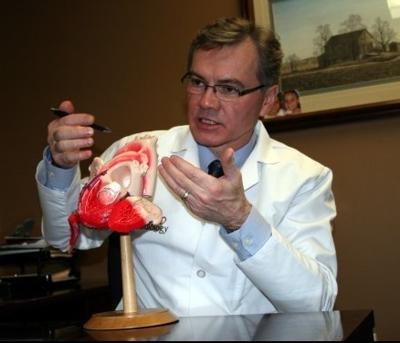


If your heart makes a whooshing sound instead of the familiar lub-dub, it doesn't necessarily mean your health is in peril, according to Mercy Cardiology Medical Director Dominic Hurley.
The detection of a heart murmur, an abnormal sound heard as blood travels through a valve or an opening in the heart, he said, shouldn't cause fear in patients as it once did 30 years ago.
Improvements in stethoscope technology and the development of the echocardiogram, a test that uses high-pitched sound waves to create a moving picture of the heart, Hurley said, allow physicians to identify heart murmurs earlier on so they can be monitored or treated if need be.
"When a heart murmur was detected, it was often very serious by then. Previous generations of physicians and patients were concerned," he said. "If you have one that's concerning it can, in most cases, be monitored for years and years before something has to be done."
People are also reading…
There are two types of heart murmurs:
- Innocent murmurs tend to be soft, quiet and short. They cause no adverse health effects.
- Pathologic murmurs, on the other hand, can progress to become long, loud and harsh and may indicate a valve problem, especially if a person experiences shortness of breath, palpitations, chest discomfort, dizziness or fainting.
"If someone has a new murmur, even if it sounds like a benign murmur, usually an echocardiogram would be obtained to establish what that murmur is doing," Hurley said.
An early start
Heart murmurs discovered at birth, Hurley said are often benign flow murmurs, which could indicate an opening in the chambers of the heart. The opening, he said may close on its own.
Adults can also develop heart murmurs.
Benign flow murmurs, which are related to increased blood flow through the heart, Hurley said, are detected during pregnancy or when a person is suffering from fever, infection or thyroid problems.
"You may hear a benign innocent heart murmur in a thin person, who has a heart that's very easy to hear, especially if that person has just performed some activity in sports or climbed stairs," he said.
Under these circumstances, the presence of a heart murmur doesn't automatically mean there is a problem with the heart, according to Hurley. Benign flow murmurs, he said, may go away and never be heard again.
"The heart is doing its job to increase the cardiac output," he said. "If you have a benign innocent murmur that's maybe heard during pregnancy or teenage years, it should not impact your life."
Pathologic murmurs are associated with aortic valve stenosis and mitral valve stenosis, conditions where the aortic and mitral valves don't open fully, and aortic insufficiency, a heart valve disease where the aortic valve doesn't close tightly.
About 2 percent of babies, Hurley said, are born with a bicuspid aortic valve, a condition where two aortic valvular leaflets fuse. When these people reach their 40s, Hurley said the bicuspid valve can narrow or become insufficient due to the condition.
Hurley said it's important to identify pathologic murmurs early on, monitor them and treatment them, if needed, with medications that either lower blood pressure and relax the arteries or lower blood pressure, stabilize the heart's rhythm and reduce lung congestion.