



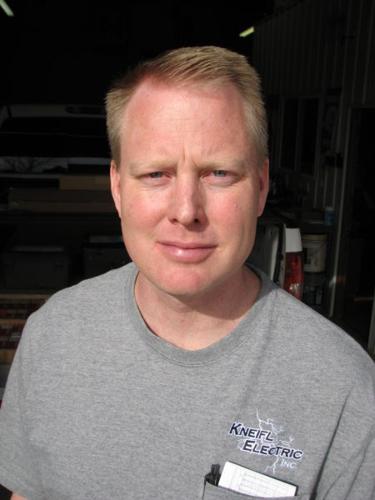
SIOUX CITY | Lonnie Kneifl uses an electrical term when describing the genesis of his interest in his chosen field.
It came more than 30 years ago when Kneifl, 43, was a 10-year-old growing up on a farm near Newcastle, Neb.
"My uncle, Neal Schulte, had gone to school to Northeast Nebraska Community College (in Norfolk, Neb.) to be an electrician," Kneifl says. "We had this old three-way switch at our farmhouse that would work if you flipped the switch downstairs. It didn't work if you flipped the switch upstairs.
"He came back from school and fixed it right away so that it worked from both switches," Kneifl says. "I was 10 at the time and it really sparked an interest in me."
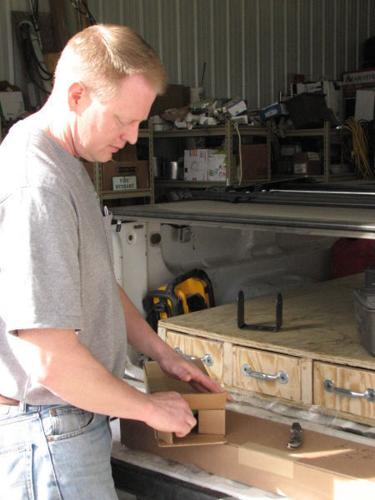
Kneifl went through the electrical program at Northeast Nebraska Community College. He worked for an electrician in Norfolk while going to college. He then worked for an area electrical firm for 17 years before establishing his own firm, Kneifl Electric, in 2009.
People are also reading…
Kneifl oversees three electricians and, together, they get the juices flowing -- literally -- in a range of residential, industrial, commercial and agricultural projects in a 50-mile radius.
When it comes to residential updates, Kneifl has seen his share of well-intentioned mishaps when it comes to outlets, extension chords, fuses and more. Generally, his advice comes down to this: Contact a professional.
"I've seen where people can take a problem and make it worse," he says. "It's best to call someone in the field to get their opinion."
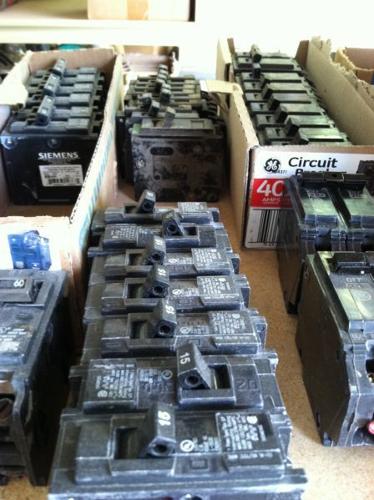
Case in point: A breaker is tripped at a home. The homeowner turns the breaker switch back to the "ON" position and nothing happens.
"That's the kind of call I get frequently," Kneifl says.
In these cases, he asks the homeowner to turn the breaker switch to "OFF" before turning it back to "ON." It's a small, but mighty important detail.
"When a breaker is tripped, it moves the switch the middle position," he says. "People think they just need to flip it back to the 'ON' position, but that's not the case. You have to turn it to the 'OFF' position first."
Other common hangups involve Ground Fault Circuit Interrupters, receptacles installed in kitchens, bathrooms, garages and outdoors.
"I get calls where you have a GFI that feeds an outlet that doesn't work and the GFI gets tripped," Kneifl says. "You must find the GFI and hit the reset."
A GFI's purpose is to trip a breaker if moisture is present, a safeguard against dangerous electrical shock.
Kneifl also deals with many residential customers who experience problems with extension cords, most notably when those chords are supplying power to space heaters and window air conditioners.
"People run a heater in a cold room, sometimes in an older home that maybe has only 10 total outlets," he says. "If the wires and breaker aren't updated, you might get damage to wiring."
Worse yet, you might have a fire.
"I would not use extension chords for heaters," Kneifl cautions.
Same goes for chords to air conditioners as those chords aren't always built to sustain the heavy electrical load.
Other common mistakes involve not "pig-tailing" wires to an outlet, or not twisting wires together before applying a wire nut.
The power behind harnessing electricity doesn't come easy. Kneifl had four years of schooling in addition to 8,000 hours of on-the-job training, which takes 4-5 years to complete. Kneifl, as a business owner, now has a hand in training those who work for him.
"On Saturday, I took six more hours of continuing education through the Nebraska-Iowa Electrical Council," he says. "We have a 910-page manual that is our bible."
While he's got 20 years of experience and 910 pages upon which to lean, Kneifl understands he doesn't know it all when it comes to shocks, surges, outages and sparks.
"I get stumped, absolutely," he says. "That's why I'm talking to contractors and other electricians all the time, sharing information."
And keeping the power "ON" for the folks they serve.


