

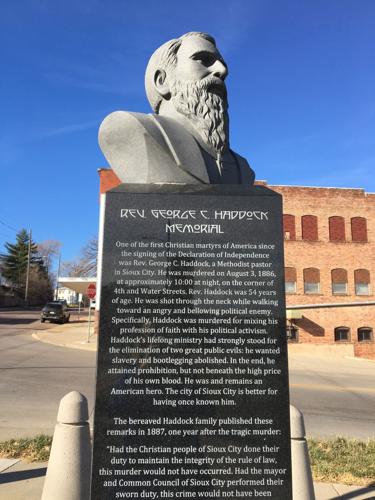
SIOUX CITY | Cary Gordon wanted Sioux Cityans and visitors alike to remember the Rev. George Haddock as more than a man of the cloth who was opposed to alcohol consumption, so with the help of the members of his congregation, the Cornerstone senior pastor spent several years working to create a monument in Haddock's honor.
That monument bearing Haddock's likeness now sits on a landscaped plot of land at Third and Water streets.
"He believed so strongly that all men are created equal in the image of God," Gordon said of Haddock, who opposed slavery and hid fugitive slaves in his home. "For that, I really think he deserves to be lauded as as hero."
Haddock, a Wisconsin-based prohibitionist, relocated to Sioux City in 1885 and eventually became the pastor of First Methodist Church.
But before the move to Sioux City, Gordon said Haddock had caused quite a "ruckus" just walking down the street on his way to vote. Besides drinking and slavery, Haddock also opposed gambling and prostitution -- two other hot button political issues of the day.
People are also reading…
"When he went to cast his vote in the state of Wisconsin, people had assembled themselves on both sides of the street and began throwing things at him and calling him terrible names," Gordon said. "Someone threw something metallic and it hit him. By the time he got to his ballot, he was bleeding all over the place. He was really a bold, brave, daring man who stood for principle."
The "fighting preacher," as Haddock was known, opposed Sioux City's local option laws, at the time, which allowed bars and liquor stores to sell alcohol under Iowa's prohibition laws.
On Aug. 3, 1886, Haddock rented a carriage with another pastor to collect evidence for a prohibition violation case. On their return, Haddock was confronted by a group of men outside a bar at the corner of Fourth and Water streets. Armed with a small metal pulley wheel attached to the end of a rope, Haddock approached the men. He was then shot and killed. Despite eyewitness accounts, no one was ever convicted of the crime. A marker was placed in the intersection to commemorate his death.
Gordon, a history buff who studied Haddock thoroughly from a doctrinal standpoint and even included him in a book he published, went in search of the historic marker one day and struggled to find it.
"It turns out it's buried in the middle of the street with dirt on it and you had to stand in traffic to look at it," he said. "It deeply disturbed me because I knew the history well enough to know no justice was really ever served to the man who killed him in the first place. It seemed like another injustice that no monument had been erected in his honor because he was a profoundly wonderful man."
The construction of the Hard Rock Hotel and Casino in 2014 took over the area where the historic marker had been located. The marker was removed and taken to the Sioux City Public Museum, where it continues to be housed.
Gordon spoke to his congregation about Haddock and his desire to recognize him in a meaningful way. The congregation raised $50,000 for a monument, plot of land a couple blocks west of the scene of Haddock's murder, landscaping and benches.
"We spent several years putting it together out of obedience to Deuteronomy Chapter 21, which requires that certain things be done when an innocent man is killed. We couldn't find anywhere in history where Deuteronomy 21 had been honored, so we decided to do it 130 years late," Gordon explained.
The monument, which was created by Hall Monument of Sioux City, is a black granite obelisk, about 6 feet tall, bearing an image of Haddock with an excerpt from a book by his son about his family's view of their father's murder. The excerpt calls Haddock "an American hero."
The monument was unveiled in August 2016, on the 130th anniversary of Haddock's murder. Gordon said a law enforcement officer fired off a black powder musket similar in caliber to that which was shot the night of Haddock's death around 10 p.m. during the ceremony.
"At that very moment, that bullet would've been fired and heard in that valley," he said. "It was a very special moment that I think everybody will remember for a long time."
In the future, Gordon said he and his congregation hope to further develop the land that sits below the monument into a park where children play.
"It would be nice if there was a fence erected around the property for safety and then some kind of a nice play area," he said. "It's such a beautiful lawn and it's not really being used. There's a lot more land there than people realize."