


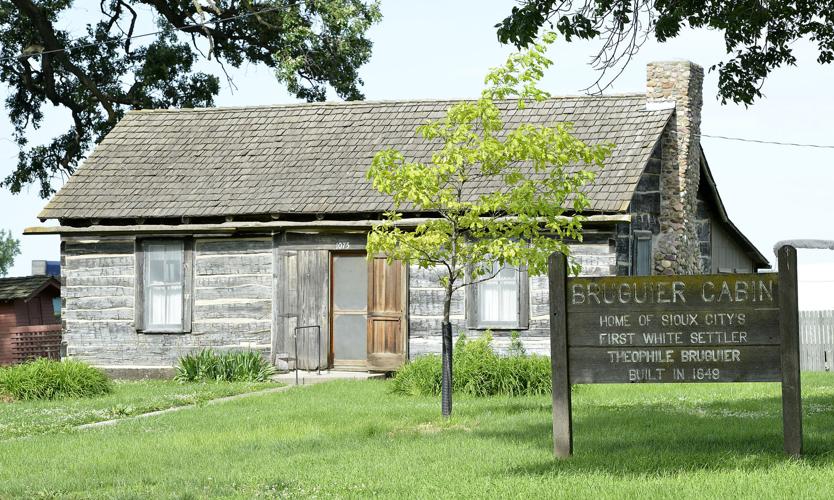




SIOUX CITY | Marvis Hendrickson laughs when asked to recall a question that may have stumped her while conducting tours and informational programs at the cabin of Theophile Bruguier in Riverside Park, on Sioux City's western edge.
The log cabin was built in 1849, five years before Sioux City was incorporated, making it Sioux City's oldest structure on record. It was discovered in 1933 by workmen reclaiming wood from old homes. After learning it belonged to Bruguier, who came to Siouxland to settle as early as 1847, officials had the structure moved to its present location in 1934.
Hendrickson and people like Jackie Warnstadt, both members of the Girls of '68, work to preserve the history of this cabin while telling the story of Bruguier, a French fur trader from Canada who befriended Chief War Eagle and eventually married two of War Eagle's daughters.
The question Hendrickson gets: "Do you live here?"
People are also reading…
While the answer is a "No," one gets the idea Hendrickson likely could envision herself in this cabin long, long ago, about the time settlers moved west and made this trapping and emerging industrial center their home base.
"Can't you just see Bruguier and War Eagle sitting together right here?" Hendrickson asked. "This is where our history took place."
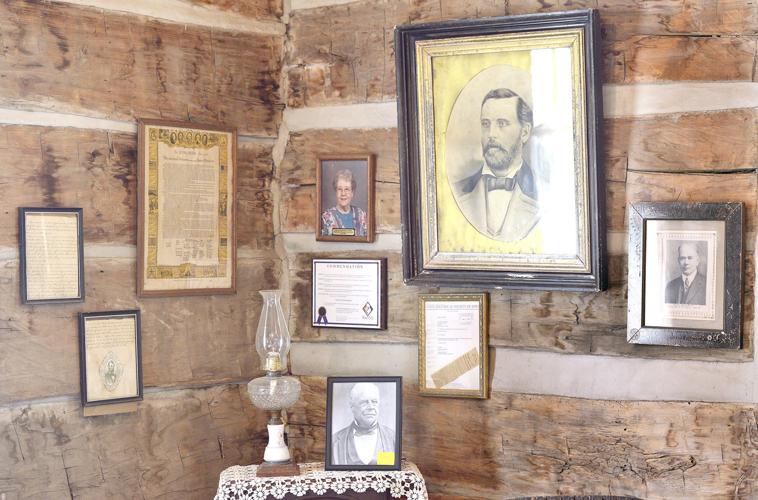
Bruguier's cabin contains photos of himself, as well as others, including Dr. John Cook, who is credited with surveying Sioux City for the U.S. government before platting the town. Cook also gave Sioux City its name 152 years ago.
Bruguier was the first white settler on this land. The Canadian trained as a lawyer, but left the trade after the death of his bride-to-be. Rather than practice law, he immersed himself in the trapping industry for the American Fur Company.
He eventually bought furs from the Sioux Indians and sold them to small fur companies. While in this line of work, Bruguier became friends with Chief War Eagle, of the Yankton Sioux.
According to Warnstadt and Hendrickson, War Eagle was never a chief. He did come with 40 followers to settle this area, but he was never formally recognized as a chief by the tribe. "His name was Little Eagle," Hendrickson said.
The Girls of '68 help maintain and preserve the stories and history surrounding this cabin and the lives of War Eagle and Bruguier. The group opens the cabin to the public from 2 to 4 p.m. on the second Sunday of each month, from May through October. This site is also a popular draw for some 1,500 Sioux City fourth-graders each year.
"They come here as part of their Iowa history project," said Warnstadt, a retired teacher who, in 2006, earned the Iowa Teacher of the Year award. She was Sioux City Teacher of the Year in 2005.
The Girls of '68 reportedly evolved from a birthday club formed in the 1890s. That, or the group arose as its members were all wed to men who formed the Boys of '68 group at that time. The name may have had something to do with a 50-year Sioux City residential requirement asked of members long ago. Members are now asked to be a Sioux City resident for at least five years before joining.
"We had a membership of more than 1,000 women at one time," Hendrickson said, noting the group now consists of 51 members.
The Girls of '68 worked more than a decade ago to renovate this historic cabin, which is modeled after a French style of tongue-and-groove architecture. The $30,000 effort helped protect the building from the elements, a necessity when considering the structure has met and withstood nearly 170 winters.
Bruguier's home isn't the only Sioux City attraction to which he is attached. He was initially buried at St. Joseph Cemetery in Salix, Iowa, after his death in 1896. But, in 1926, the Junior Pioneers deemed that he should be buried with his Indian wives, Flaming Cloud and Dawn, and their children.
After reaching an agreement with family members, the city and officials within the Sioux City Catholic Diocese, had his body disinterred, as well as that of his third wife, Victoria Turnott, and brought to the bluff overlooking the Missouri River on Sioux City's west side.
It is there, at War Eagle Bluff, that Bruguier found a final resting place, along with his first two wives and two infants.
"Bruguier had his children speak French to him, native language to their mother and English to their doctor," Warnstadt said.


