


If you have a garden, either for vegetables or flowers, one of your regular recurring tasks is to prepare the ground for planting.
It may be something as simple as removing a completed vegetable crop and smoothing the ground for a succession crop. It might be something that involves a lot of physical effort to break up undisturbed sod and prepare the ground to start a completely new flower bed or vegetable garden.
My basic premise is that you are a typical homeowner who is working in a relatively confined area. Your choice of tools would range from rototillers to hand tools since tractor mounted implements would be too large to access the area or economically impractical for the typical home project.
HEAVY GROUND BREAKING is something that only needs to be done one time. If you are going to do it yourself, then renting a tiller is probably in your plan. There you have two options, either a fairly lightweight front tine tiller or a heavy duty rear tine tiller. The rear tine style is much more effective. This machine will be well worth the additional cost in time savings and reduced physical effort.
People are also reading…
The rear tine style has powered wheels that pull the machine along. The rear tines are rotating against the movement direction and the digging action is actually upward. This pulls the tines down into the ground, so it digs to full tine depth, and keeps the machine from jumping around if you happen to be digging in dry. hard ground.
In contrast, the front tine style has only the machine weight to force the tines down into the ground. If the ground is dry and hard it really just scrapes the dirt, and the downward action of the tines results in a lot of jumping that is hard to control, and physically tiring. Generally new ground will require multiple passes to loosen the soil to full tine depth.
After loosening the desired area, cover the new space with several inches of compost, peat moss or similar soil amendments that will loosen the soil and add organic material. Spread the material uniformly over the area and retill to blend it into the soil.
RECONDITIONING EXISTING PLOTS is the normal requirement once a bed or garden area has been established. The vegetable gardener has the entire garden to get ready for spring planting. If limited time is a factor and the area is sizeable, then using a tiller to complete the job at one time is a desirable option. Since the ground has been previously planted, the soil will be soft, and either a front or rear tine machine will accomplish a satisfactory result. Primary considerations are rental cost and ease of transportation. The front tine style will be less costly and two people can easily lift it in and out of a large trunk or SUV. Rear tine models are significantly heavier and will require either a small trailer or some ramps to load it into a pickup.
One negative aspect of annually tilling the garden is the aggressive action completely pulverizes the soil. This destroys the soil structure that normally develops over the growing season. If you have taken a garden fork and lifted a chunk of soil without breaking it apart you have probably observed that the soil particles have aggregated into larger clumps of dirt and there are small tunnels through the ground created by the earth worms. This is the soil structure that facilitates the movement of air and water into the root zone, promoting plant growth and reducing washing and erosion. Tilling also brings latent weed seeds to the surface where the soft ground and lack of competition causes them to germinate long before your planted seeds.
If you have a raised bed garden with walkways, then the soil does not become compacted from foot traffic. All that bed preparation requires is lifting with a fork so the old crop residue and roots can be removed.
Regular garden areas become compacted as you walk through the rows harvesting crops or weeding. If you are reworking only small sections at a time, then hand digging with a fork works well since it retains the soil structure, and loosens the roots of grass and weeds so they can be easily removed before planting a new crop.
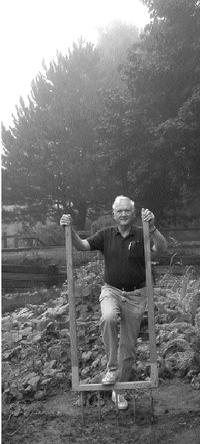
This year, I tried something new. Some of my garden books written by New Englanders mention using a broad fork to break up the soil in their vegetable beds. I have never seen such a tool, but there was a picture in the book. I went to my material resource storage (the wife calls it the junk pile) and found what I needed to construct a tool. It is a 24 inch bar with 5 -12 inch tines and a long handle on each end.
To use the tool you step on the bar and push it into the ground the depth of the tines. Then just step back, pulling on the two handles. As the tines rotate upward, the dirt is lifted and broken into large chunks. I was able to rework a 100-square-foot section in about 10 minutes. To accomplish the same with a regular fork would have taken 25 minutes. I would have been out of breath and had a sore back from the bending and lifting. After raking the area to level the surface it was ready to replant with a new crop.
If you want to learn more about a broad fork run an internet search for garden tools, broad fork.
WEEDING AND CULTIVATING has a the primary purpose controlling of undesirable plant growth, but is also serves to recondition the soil by breaking the surface crust that develops from rain or watering. Heavy rain on a crusty surface tends to run off before it can be absorbed. A few minutes a day with a hoe keeps the weeds under control and breaks up the surface crust to enhance water absorption. Water loss is reduced during hot weather by interrupting capillary action which draws subsoil moisture to the surface..
If you have difficulty finding time to hand control the weeds, then you might want to consider one of the lightweight (about 20 pounds) tiller/cultivators that are available. These machines can be controlled to dig an inch or less to only cut the weeds and break up the surface. I have one that acquired when I still worked. With it I could weed the entire garden in 20 minutes instead of an hour or two with a hoe. Mechanical cultivation requires a little more row spacing so you don't plow up your plants.
For questions or further information contact Woodbury County Extension 712-276-2157.


