


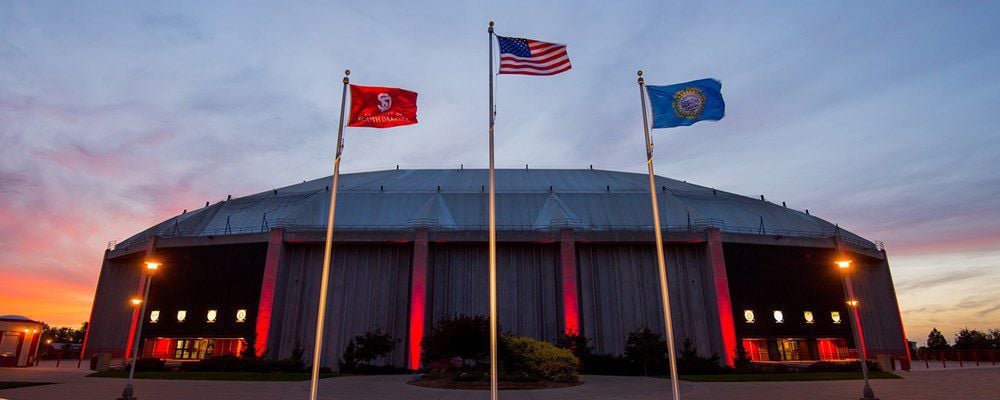
VERMILLION, South Dakota -- The University of South Dakota's DakotaDome has scored a $26 million facelift.
The state Board of Regents in December approved a renovation plan for the the 10,000-seat indoor complex, which became one of the nation's first multi-purpose domes when it opened in 1979.
An iconic portion of the USD campus, it's hard not to notice the large gray roof looming on the northern part of the university in Vermillion.
In 2001, a $13 million steel roof was installed, replacing the original fabric roof. A few other upgrades have been made over the years, including the installation of a video board, concourse and concession improvements, women's locker room renovation and press box updates.
“We need to ensure that the dome is as viable a facility for this state for the next 40 years as it has been for the previous 40," South Dakota Athletics Director David Herbster said.
People are also reading…
The modernization project will follow completion of two recent projects to augment USD's athletic facilities.
The university in 2016 finished the Sanford Coyote Sports Center, as part of the $66 million Sports Performance Enhancement Facility project. The Sports Center, located just south of the DakotaDome, includes a 6,000-seat arena for men's and women's basketball and volleyball.
The new arena freed up space in the dome for other purposes, Herbster said.
“We were so hamstrung on the constraints of space that we had nowhere to go. We couldn’t address any facility issues," he said. "If we want this program to continue to be successful, we need to have the facilities that not only will attract and retain student-athletes and coaches, but especially our fans. We have to improve our fan amenities.”
Herbster envisions two phases of dome work, with a substantial number of items in each one.
Of the estimated $26 million price tag, $6.4 million would come from USD capital funds and $5.4 million from South Dakota’s Higher Education Facility Funds, leaving $14.5 million to be raised by private donations.
USD Assistant Athletic Director for Sports Information Bryan Boettcher said Herbster has begun the process of requesting a renovation that addresses locker rooms and other aspects for football, softball, soccer and tennis. Updates to the infrastructure, including lighting, sound system, restrooms and the heating and cooling system are also included in Phase One for the DakotaDome.
In a second phase that could follow, the bleacher seating on the west side, where students often sit for football games, could be modernized to have seating like the more extensive east side of the dome.
“The Dome was originally designed to have permanent seating on both sides,” said Herbster. “It is time that we repurpose all of that space on the west side to make game days more enjoyable for our community."
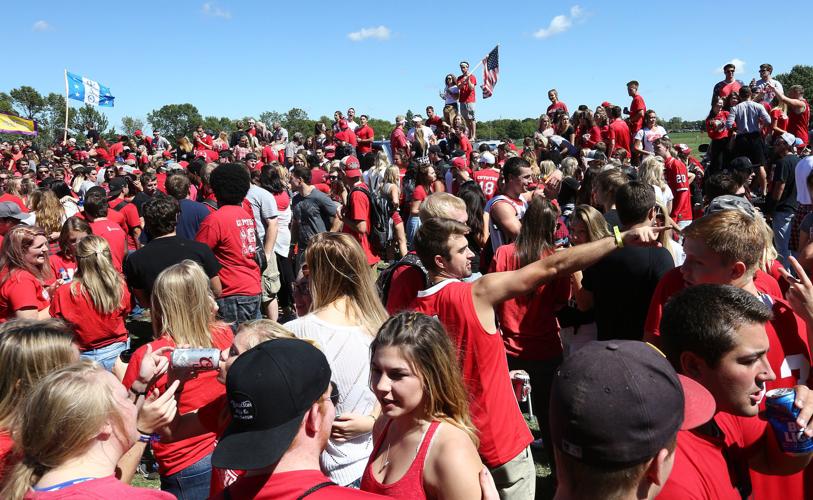
Ways to address game-day seating, which currently has the capacity to accommodate 2,000 students and band members, are part of the two phases.
“The idea is to design the entire seating arrangement on the west side from the floor to the top, but this initial phase will only construct seating from the playing surface to the concourse. My job is to continually raise money so we can go into Phase Two, which includes seating from the concourse up, as quickly as possible," Herbster said.
Herbster would also like to find a way to add two new dome entrances on the west side, and a concourse on the west side for concessions, food and restrooms is a priority. Currently, the dome public entrances are only on the east side.
Beneath the concourse on the west side will be a new football locker room, meeting rooms, an equipment room and a training room. Herbster said the current football locker space is less than 1,500-square feet, which is too small for a roster of 100 players.
Additionally, Herbster wants Phase Two to include a new swimming pool attached to the Wellness Center, which is located east of the DakotaDome. Removing the pool from the dome's lowest floor would allow renovations on the east side, which could widen the concourse and increase the size of the main restrooms.
Funding for the work requires approval of the Board of Regents and the state Legislature. If approved this year, implementation of Phase One could begin by 2019 and perhaps be finished by summer 2020.


