


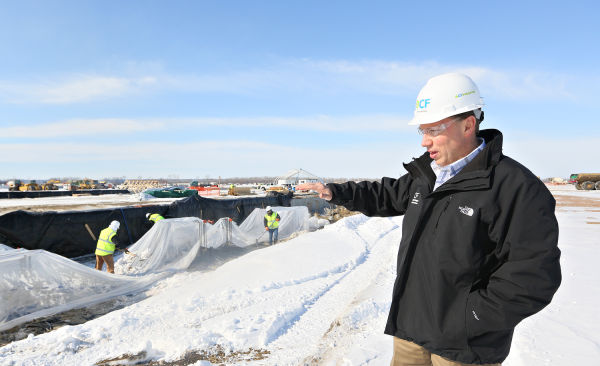
SERGEANT BLUFF | Nick DeRoos stops his SUV on a bluff overlooking a snow-covered field.
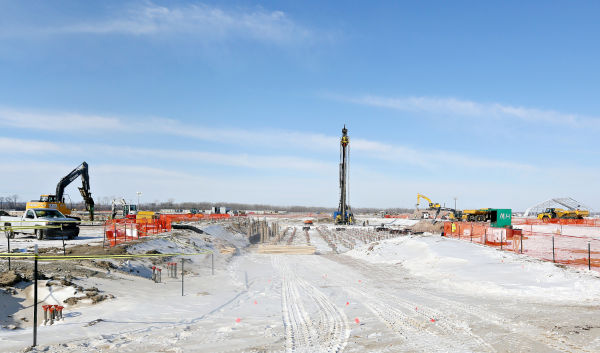
Stepping out of the vehicle, the CF Industries Port Neal plant manager watches a cluster of towering cranes and pile rigs that dot the landscape.
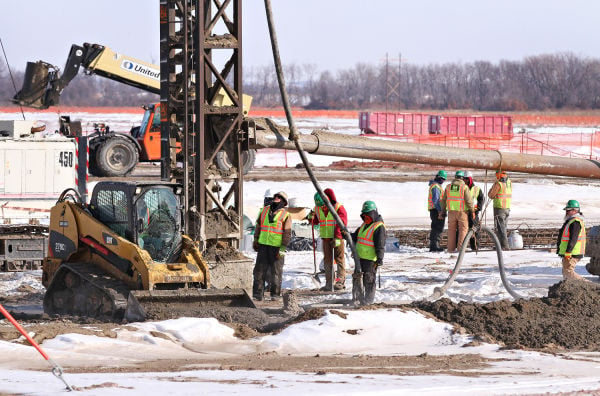
Hard hat-clad workers, bundled up for the chilly March 4 morning, guide the rigs as augers burrow as deep as 102 feet into the ground. The holes, measuring as large as 24 inches in diameter, is filled with concrete, reinforced with steel rebar for added strength.
For several months, crews have been laying the foundation for a series of structures in CF's $1.7 billion expansion of its Port Neal nitrogen fertilizer complex.
"When you look at the project right now, you can't see anything other than the equipment doing the subterranean work," DeRoos said while giving a Journal reporter and photographer a tour of the 150-acre site.
People are also reading…
By the middle of the summer, steel beams are expected to start rising up out of the ground, followed by the installation of huge vessels such as distillers and reactors.
Everything about the project, scheduled for completion in 2016, is enormous, starting with the estimated price tag, which was the single largest investment in Iowa history at the time it was announced on Nov. 1, 2012.
The expansion is projected to create 100 permanent jobs, doubling CF's Port Neal workforce, and 7,000 indirect jobs generated through increased additional economic activity required to support the larger plant.
After securing a series of permits, the Deerfield, Ill.-based company broke ground last fall, starting with moving dirt and laying aggregate.
More than 1.35 million cubic yards of soil is expected to be excavated during the project, or 33,689 loads on 40-yard dump trucks, according to the company. If lined up, the trucks would stretch 383 miles, the distance from Sioux City to Madison, Wisc.
In excess of 592,238 tons of stone, sand and gravel, or 394,825 cubic feet, are expected to be used for the building site, new roads and a temporary parking lot for workers.
That's the equivalent of 25,750, 20-yard trucks, stretching the length of 5,150 football fields, or 293 miles, the distance from Sioux City to Iowa City, according to the company.
By project's end, more than 145,365 cubic yards of concrete will have been poured, the equivalent of 14,537, 10-yard trucks, or an average of 40 trucks per day for an entire year.
Building the new plant will require 17,992 tons of structural steel, or the combined weight of 5,997 Ford F-250 pickups. Each super truck weighs about 6,000 pounds.
A labyrinth of 416,018 feet of piping also must be installed. If lined up end to end, the pipes would extend 79 miles, from Port Neal to the Interstate 29 junction with Interstate 680 in Omaha.
Scores of materials and supplies are arriving via truck and rail. But some items are so heavy or bulky that they will have to be brought up on Missouri River barges.
Barges haven't been used on the waterway locally in about a decade. CF has been building a heavy-duty road to transport the materials from the river to the construction site.
The first barges are expected to arrive in the first part of the spring navigation season, sometime in May, DeRoos said. The cargo will include vessels that weigh as much as 500 tons each and are up to 28 feet in diameter.
A typical semi-truck trailer can carry up to 80,000 to 100,000 pounds, in comparison.
About 300 construction workers are currently at the job site, located just north of CF's existing nitrogen plant, and just south of Sioux City. Staffing is expected to ramp up throughout this year, with the number swelling to as many as 2,000 at peak construction, anticipated for between January and May 2015.
The longer the project ends up taking the lower the peak might be," said DeRoos, who also serves as the project manager. "If we're really progressing well and weather isn't a factor... then it could compress the schedule, which could cause manpower to peak a little bit higher."
By July or August, pipe fabrication is expected to begin, he said. Plans call for enclosing the new structures by year's end, allowing electrical and mechanical work to get under way and continue throughout next winter, he said.
Despite lengthy spells of subzero temperatures this past winter, contractors have made good progress on the underground work, DeRoos said.
When finished, around 7,000 pile holes will have been drilled, filled with concrete and rebar and fitted with foundations.
Both auger cast and Dewaal pile rigs are deployed. The latter is a European-style pile that uses a screw-shaped tool that penetrates dense soil layers without decompressing the soil. The dirt instead is displaced laterally against the side of the hole, strengthening the pile.
Most of the holes are 60 to 80 feet deep and 18 inches in diameter.
On another portion of the job site, other crews are building the foundation for a warehouse measuring 210 feet wide and 1,702 feet long, or almost a third of a mile. One of the largest in North America, the warehouse will store up to 154,000 tons of granular urea, a solid nitrogen fertilizer that hasn't been produced at Port Neal in 20 years.
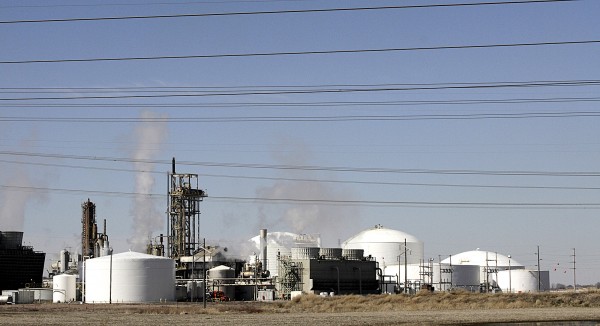
The massive project, which will triple the complex's production of ammonia, the basic building block for nitrogen-based fertilizer, calls for construction of a 2,420-tons per-day ammonia plant and a 3,850-tons-per-day urea synthesis and granulation plant.
Port Neal's ammonia production currently goes toward two liquid nitrogen-based fertilizers, anhydrous ammonia and urea ammonium nitrate solutions, or UAN.
Granular urea can be applied separately or mixed with phosphate or potash fertilizers.
The U.S. currently imports more than two-thirds of its urea production, giving CF and other North America manufacturers an incentive to boost domestic production.
The added Port Neal production will replace higher-priced fertilizer imported from other countries, helping farmers in Iowa and other Midwest states save millions of dollars annually.
CF, North America's largest producer and distributor of nitrogen plant nutrients, is spending a combined $3.8 billion to expand production at Port Neal and a facility in Donaldsonville, La.
Demand for nitrogen fertilizer, which must be applied to corn and certain other crops to add nutrients to the soil, has surged in recent years as farmers, spurred by rising grain prices, plant more acres.
Also playing a key role in CF's decision to expand: new technologies that extract natural gas from shale rock formations in North America. That's lowered prices for the fuel, which accounts for about 70 percent of nitrogen production costs.
As part of the deal that led to CF expanding at Port Neal, Northern Natural Gas agreed to bring in a larger pipeline to serve the heavy industrial site.
CF hired German-based engineering firm of ThyssenKrupp Uhde to design the Port Neal and Donaldsonville plants and perform other duties, which include procuring specialized equipment.
Other lead contractors include Baton Rouge, La.-based CDI Corp. and Performance Contractors Inc.
While the construction proceeds, CF is well into the hiring of operators, engineers, millwrights, mechanics, maintenance personnel and other workers to staff the new plants.
DeRoos said 92 of the 100-plus positions have been filled. In August, the first class of new operators graduated, allowing them to begin their training before the new plant comes on line.
The new jobs will start at average salaries of $55,000, and increase to about $85,000 after the workers complete certification.


