



SIOUX CITY | Thomas Jefferson is making Sioux City home at the Lewis & Clark Interpretive Center in 2015.
Not literally, of course, but rather an $40,000 animatronic version designed to educate about one of the biggest supporters of Meriwether Lewis and Williams Clark’s expedition. He will join animatronic versions of Lewis, Clark and dog Seaman.
“Lewis and Clark, as instructed by President Thomas Jefferson, compel us to explore everything from Native and other cultures to traditional games to natural resources, especially the Missouri River, to music, agriculture, our military and much more,” said Director Marcia Poole. "The animatronic Thomas Jefferson will hopefully inspire curiosity about this president that went to Congress and asked for money for the expedition.
"It's going to be, I think, quite an addition," she said.
People are also reading…
The Lewis and Clark expedition is the Center’s core which inspires broad and varied themes for programs and exhibits. In 2014, the Center presented 46 programs, installed five exhibits and welcomed dozens and dozens of tour groups, most from schools in Iowa, Nebraska, South Dakota and Minnesota.
They also welcomed 31,042 local and area visitors as well as visitors from as far away as Australia, South Korea, India, Haiti, Taiwan, Germany, Colombia and other distant places.
The popular weekend programs are a big draw for the Center.
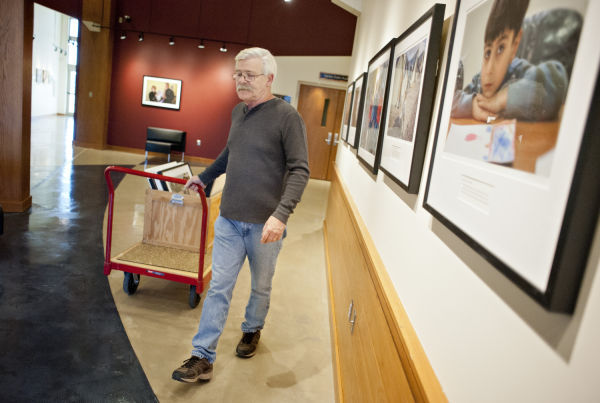
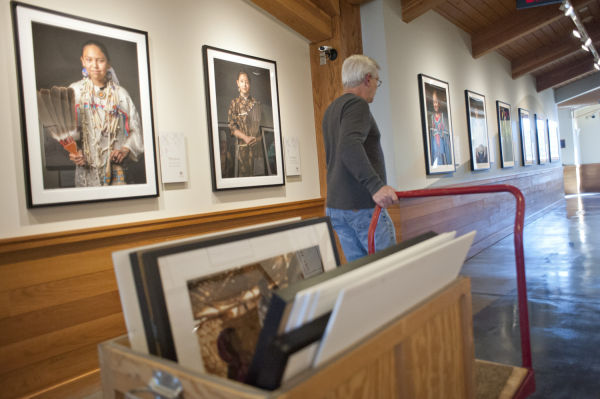
“Don Doll, S.J. On Assignment,” with the award-winning photographer, went on display March 15. Doll gives visitors insight into his work with the Jesuit Refugee Service (JRS).
“Thanks to our Lewis and Clark core, we never run out of ideas for planning stimulating programs and exhibits,” Poole said.
The Lewis and Clark Expedition often is described as America’s greatest road trip. Since opening in 2002, the Lewis & Clark Interpretive Center/Betty Strong Encounter Center has embraced that description with exhibits, programs and activities about the explorers’ time in the present-day Siouxland, from late July to early September 1804.
The Center’s road trip, however, doesn’t end in September 1806 with the Corps of Discovery’s return to St. Louis. It continues, fueled by a permanent mission of encountering stories of the past, present and possible future of the natural resources and diverse people of Siouxland.
ENCOUNTERING THE PAST
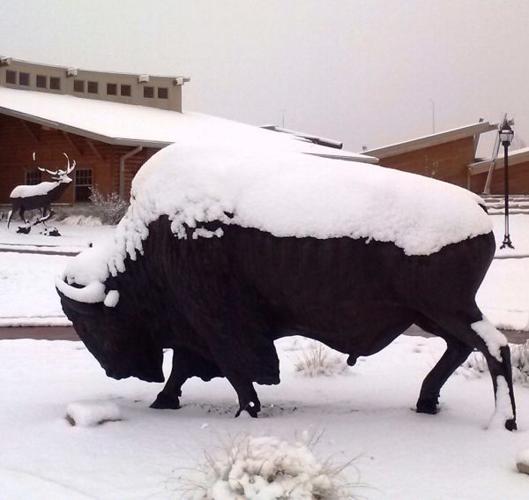
Encounters begin on the Center’s Missouri Riverfront grounds with life-sized, bronze sculptures of Plains animals, including a bison, elk, grizzly bear, white-tailed deer, two coyotes and a marmot. Created by Wyoming artist Mike Flanagan, each sculpture embodies stories about Lewis and Clark and Native peoples they encountered.
The 1,000-pound “buffalo” sculpture, for example, helps visitors imagine Lewis and Clark’s unsuccessful efforts to sponsor a peace council between the Otoe-Missouria and the Omaha tribes to promote U.S. trade interests. The Omaha people had been devastated by smallpox. Those who remained reportedly had left their nearby village to hunt buffalo.
Overlooking the animal sculptures, the 14-foot-tall “Spirit of Discovery” depicts Capts. Lewis and Clark, and Lewis’ Newfoundland dog, Seaman. Created by Loveland, Colo., artist Pat Kennedy, the bronze sculpture shows the captains in dress uniform in a relaxed moment, looking out over the Missouri River. Seaman sits between his master and Clark. The sculpture has become one of Siouxland’s most prominent photo ops.
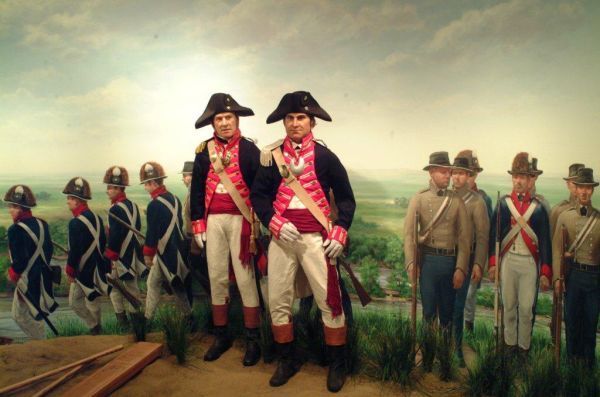
While in the Center, visitors travel back to the Corps of Discovery’s time in the area. Murals by Split Rock Studios, journal stamping stations, computers, flip books, text-and-graphic panels, lift-and-drop panels, a brass-rubbing station, reproductions of military uniforms and equipment, and traditional Native games offer a broad range of entry points for learning about the Corps of Discovery’s time in the present-day area.
In the Enlistment Center, visitors may “enlist” by stamping one of the eight expedition roles: Lewis, Clark, York, Sergeant, Private, Indian, French Boatman, Hunter. Sacagawea does not figure in the Center’s story; the Corps would not meet her until November 1804 in present-day North Dakota.
Visitors proceed to meet the ailing Sgt. Floyd whose symptoms suggest a ruptured appendix. The treatment is described in the context of his time. With his death and burial, animatronic mannequins of Lewis and Clark eulogize the “young man of much merit” on a bluff over the Missouri River. They discuss the impact of Floyd’s death on the other soldiers and regret that he could save him. The scene is complemented by the story of Floyd’s original grave site, marked by a “seeder post,” to the 100-foot sandstone obelisk erected in 1901, his fourth burial site.
Visitors learn about the election of Pvt. Patrick Gass to succeed Floyd. They gain insight into the court martial of deserter Pvt. Moses Reed and the punishment considered exceptionally harsh by the Otoe Missouri.
The Sioux City Lewis & Clark Interpretive Center and adjoining Betty Strong Encounter Center comprise a private, nonprofit cultural complex at 900 Larsen Park Road. It was built and is sustained by Missouri River Historical Development, Inc. (MRHD).
Admission is free. Hours are 9 a.m. to 5 p.m. Monday through Friday, noon to 5 p.m. Saturday are Sunday. It's closed Monday.


