


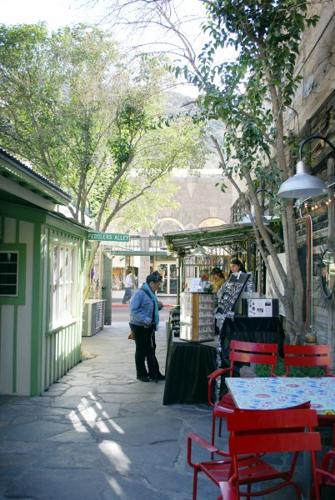
BISBEE, Ariz. - This unique town with its old world charm is located on the vast Arizona desert about 90 miles southeast of Tucson. The narrow winding streets and houses perched on the sides of hills offer picturesque views. The downtown area has a wide range of art and culture in the many small shops lining the narrow winding streets. Bisbee is also the perfect place for nearby outdoor activities such as bird watching and hiking. Although Bisbee is now a diamond in the desert it began its life as a much rougher gem.
The story of Bisbee begins in the late 1870s when Lt. Dunn who was in charge of a cavalry detail from the nearby frontier Army post of Fort Huachuca was on a scouting mission against the Apache Indians. The soldiers picked a flat spot of land near a spring in the Mule Mountains to camp for the night. That site is now Old Bisbee and not far from what would become the Copper Queen Mine.
While walking around the area Lt. Dunn found some interesting rocks on the south wall of the canyon. Dunn wanted to file a claim on the property but because he was in the army that wasn't possible. He struck a deal with George Warren a local prospector who agreed to locate claims and work the property with Dunn as a silent partner. However, Warren stopped at a saloon on the way to the site to indulge in his favorite pastime of drinking too much whiskey. After a few drinks Warren had new partners and Dunn was out of the picture. However, Warren was to later lose his claim in a horse race. The colorful character George Warren is so much a part of Arizona history he's featured on the state seal.
People are also reading…
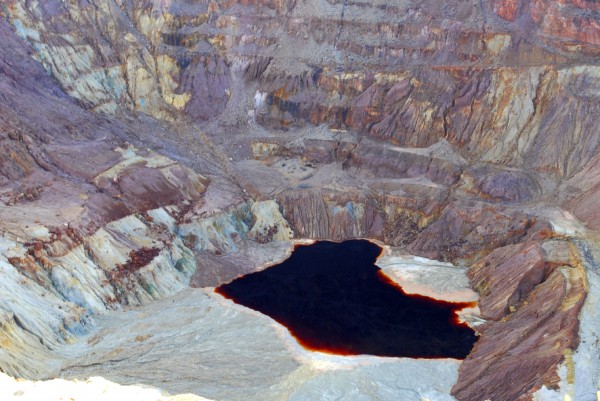
Copper mining in Bisbee began in 1880 and soon large companies bought out individual claims. Phelps Dodge Corporation and its subsidiary the Copper Queen Consolidated Mining Company became the sole operator of the mining district in Bisbee. Since that time Phelps Dodge has been one of the largest copper producers in the United States.
After almost 100 years of continuous production the copper mines in Bisbee closed in 1975. During that time the mines produced metals valued at $6.1 billion (at the 1975 price). A staggering production of 8,032,352,000 lbs of copper, 2,871,786 ounces of gold, 77,162,986 ounces of silver, 304,627,600 lbs of lead and 371,945,900 lbs of zinc came from the mines.
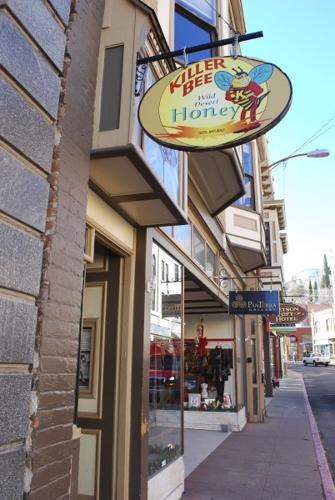
Today visitors can tour Bisbee and see many of the old buildings that were there during the town's early days. One prominent building is the Copper Queen Hotel, Arizona's oldest continuingly running hotel. The downtown area is filled with specialty shops offering everything from unique clothing, books to antiques. There are also many cafes and restaurants with food for every taste.
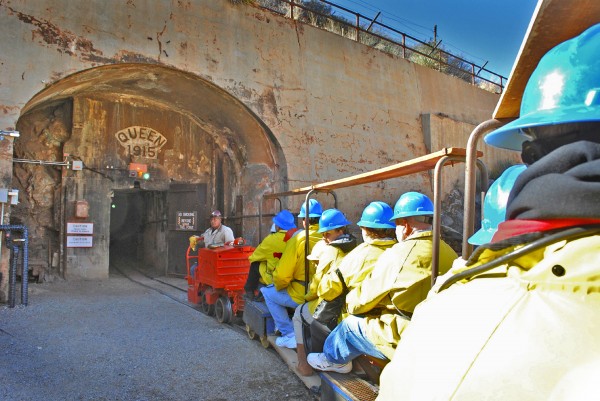
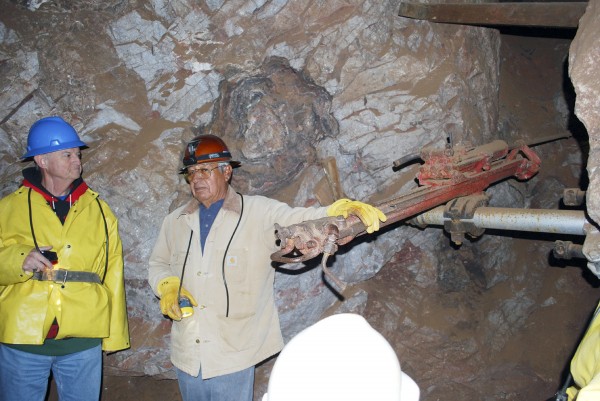
One favorite spot for tourists visiting Bisbee is the Copper Queen Mine. In the old days the Copper Queen Mine was the source of rich copper ore and was one of the greatest sources of copper ever discovered. Visitors can don hats, lanterns and slickers just like the miners wore and venture deep into the mine to experience what it was like to work in the Copper Queen.
The tour begins at the visitor's center where tickets are purchased. While waiting for the next tour to begin visitors can look at displays depicting the history of mining in Bisbee or walk through the gift shop. Just before the tour begins everyone gets outfitted with hardhats and lanterns just like the miners wore. Visitors also wear slickers to protect their clothes while in the mine. Next everyone climbs aboard a small train operated by a tour guide for the trip 1,500 feet into the depths of the Copper Queen Mine.
Every tour guide is a former miner who is knowledgeable about mining operations and the history of the Copper Queen. As the little tour train winds its way underground through the Copper Queen Mine there are stops along the way where the guide shows visitors how the work of getting the copper was done.
Joe, a tour guide said the Copper Queen Mine opened in 1877. "All the mines in Bisbee were closed in 1975," Joe said. "The Copper Queen tour opened in 1976." Joe said working in a mine back in the early days was a dangerous occupation. One particularly dangerous aspect of mining the copper was the use of dynamite. Miners would drill holes in a wall then place sticks of dynamite in the holes. "They would do it at the end of the shift to give some time for the dust to settle," Joe explained. "Each stick of dynamite had a different length of fuse so they would go off in sequence." He said if one stick didn't go off it was the responsibility of the next shift to check it. "Now that was dangerous."


