


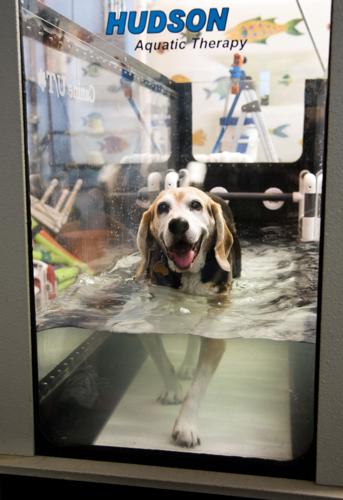
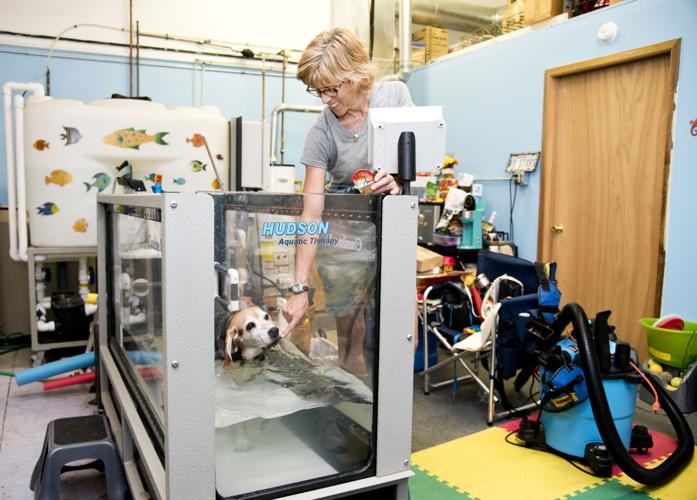
SOUTH SIOUX CITY | A hefty, 13-year-old beagle hobbles into a glass tank. The door closes behind him and water begins rising up from his paws, past his bowed elbows and up to his belly before stopping at his shoulders.
The underwater treadmill rolls along at 1.3 miles per hour. Jean Gill, a certified canine rehabilitation practitioner, has to coax him into motion with small licks of peanut butter.
“He has me trained,” she said. Gill doesn’t resort to bribery with her other clients at Four Paws Fitness & Rehab. Shadow’s spoiled.
More than two years ago, the aging dog was crippled and overweight. His owner, Julie Kaplan, used to take him on two long walks every day, but then her beloved beagle didn’t want to go as much anymore.
“He started getting really cranky, which is not his normal disposition,” she said.
People are also reading…
Shadow was diagnosed with severe arthritis and, around the same time, tore his ACL. The veterinarian recommended aqua therapy at Four Paws Fitness & Rehab, which Gill opened in 2013.
Kaplan initially wrote it off because Shadow’s scared of water but finally went to check it out. She found that it’s nothing like a traumatic bathtime experience where a dog’s doused in a bathtub or sprayed with a hose. Instead, the water gently pools into what looks like a giant fish tank.
Now, he comes in twice a week to walk on the treadmill for 20 minutes. Through aqua therapy, he’s shed a few pounds and regained some mobility.
“It’s really hard on old dogs to get their core muscles going,” Gill said. “When they start to get arthritis and get a little stiff, they stay within their safety zone of walking, which means they don’t do a lot of trunk twisting and engagement so their core muscles kind of turn to marshmallows.”
“Kind of like us,” Kaplan said.
“And some humans have this issue as well,” Gill said, laughing. “We all hate to do crunches, right?”
Exercising in the 90-degree water gets those hard-to-reach core muscles working again.
For really arthritic dogs like Shadow, Gill fills the tank to their shoulders for maximum buoyancy, which takes weight off the joints.
A normal dog bears over 60 percent of its weight on its front legs. When dogs get arthritis in their hindquarters, they shift even more weight to the front to alleviate the pain, which leads to muscle loss. Owners may not notice until it’s too late, and their dogs no longer climb stairs, jump into the vehicle or lie down comfortably.
“The movement of pushing and pulling through the water is accessing muscles that they can’t access on land because it’s too painful,” Gill said. “They build up the muscle mass to their hind end and get that comfort level coming back and that ability to get back up.”
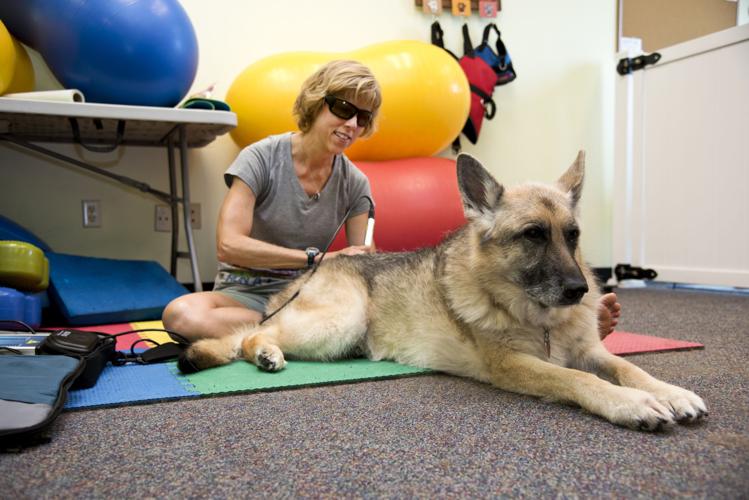
In addition to canine hydrotherapy, Gill offers laser treatment, massage therapy, conditioning programs and other exercises where dogs work on balance balls or walk on a regular treadmill. These services can benefit dogs whether they’re injured, athletic or overweight.
While she’s been an occupational therapist since 1999, Gill only recently got into dog rehab after her German shepherd was diagnosed with degenerative lumbosacral stenosis, a painful condition caused by the narrowing of the spinal column.
She was driving over an hour, twice a week, to bring Echo to therapy. Given her profession, she was encouraged to pursue education in the emerging field of canine rehabilitation.
Now, she works with dogs at Four Paws Fitness & Rehab three days a week, and she still does occupational therapy for their two-legged companions, too.


