

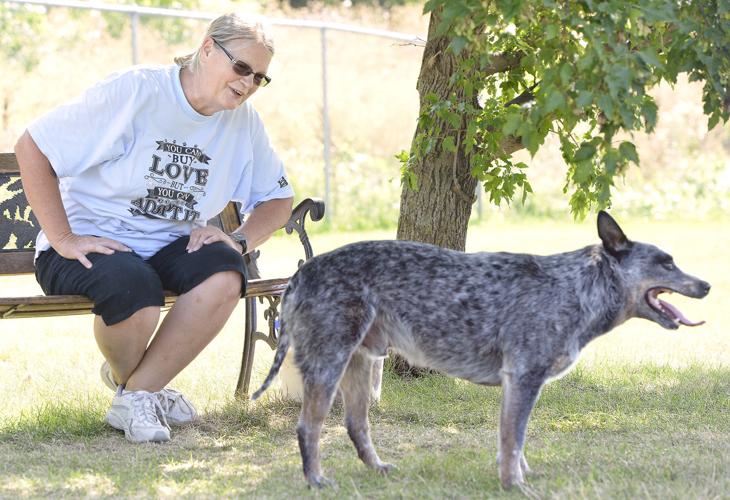
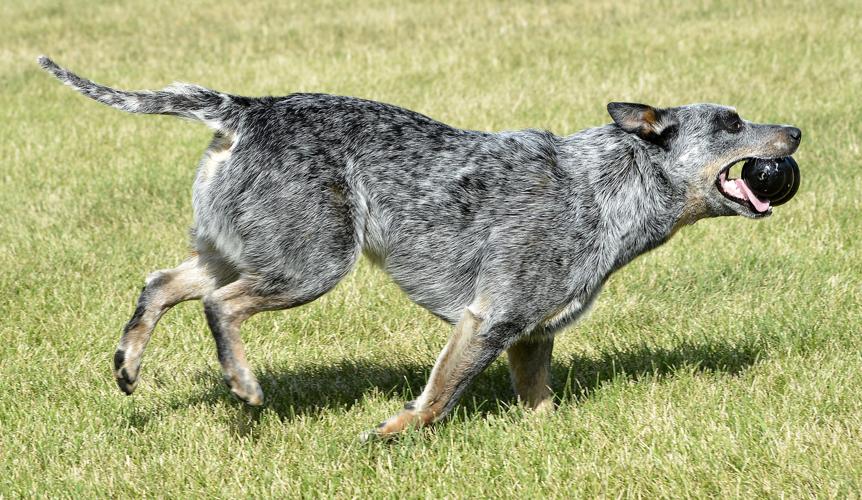
SIOUX CITY | Bingo, a 2-year-older blue heeler, is very protective of his personal space.
The energetic dog lets out a series of loud yelps whenever somebody passes by his kennel at the Siouxland Humane Society.
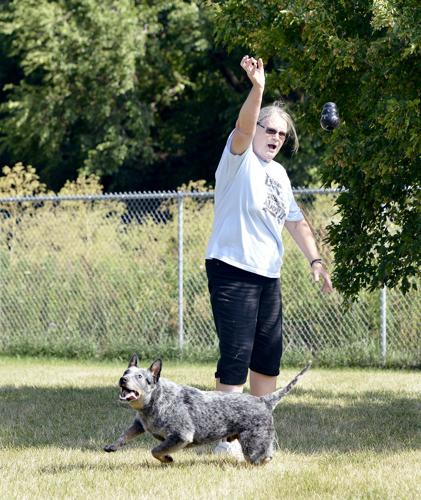
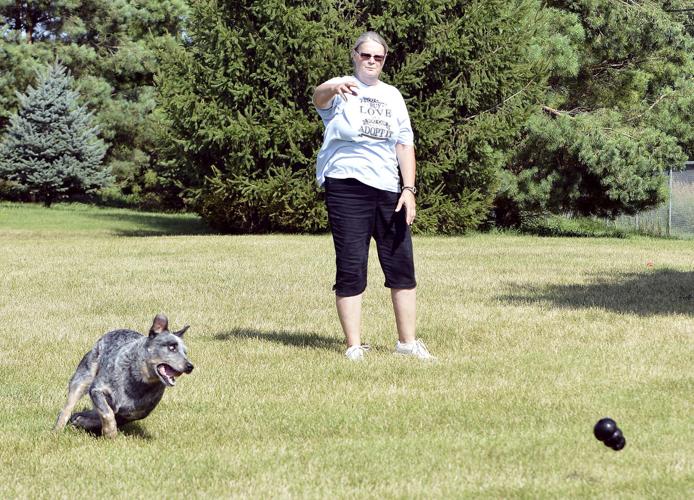
However, that doesn't happen when Joyce Rasmussen plays with Bingo in the field behind the Tri-View Avenue facility.
"No, Bingo's just a good boy," Rasmussen, a volunteer, said of the rambunctious dog. "He's just looking for attention and needs someone to love him."
A retired school teacher, Rasmussen began volunteering her services at the Humane Society more than a year ago.
"I've been a dog person my entire life and I've always had an affinity for them," she said while tossing a chew toy for Bingo to catch. "My job is to help socialize dogs into potential pets."
People are also reading…
The socialization process is more in-depth than simply getting a dog to behave. Instead, it requires mutual respect between human and canine.
"Animals have a sixth sense when it comes to people," Rasmussen said. "They know it when we're nervous and that makes them nervous."
Which is why Rasmussen waits for the dog to approach her and not the other way around.
"A dog's first defense is to run away if frightened," she explained. "If you don't give them a reason to be scared, they won't be."
Dog socialization requires time and patience
"The perfect time to socialize a dog is between the ages of 3 weeks and 3 months," Rasmussen said. "That's when they're up for anything."
Dogs up for adoption at the Humane Society run the gamut in age.
"You know the expression, 'You can't teach a dog new tricks'?" Rasmussen asked. "Well, you can. It simply takes more time and a lot more patience."
This is especially true if a dog previously has been abused.
"Dogs can't speak up and tell us their life stories," she said. "Perhaps the dog is being wary or fearful for a good reason. You never really know what you're up against."
Setting desired goals
"What do you want your dog to achieve?" Rasmussen said. "Probably being comfortable with you and your family."
That's why she thinks the best thing you can do for a dog is to expose them to a wide variety of people.
"Dog owners may think they're being protective of their pets," Rasmussen said. "Instead, you should encourage your dog to explore new situations and new people."
Finding the perfect companion
Some dog-human relationships, however, don't work.
"If a dog is used to a quiet household and a one-on-one relationship with his owner, adoption into a family with children may not be desirable," Rasmussen said.
Plus, having a very active dog like Bingo wouldn't work for an apartment dweller.
"The way Bingo likes to play catch makes me think he was a football player in a previous life," Rasmussen said with a laugh. "Bingo's the type of dog who definitely needs a job to perform and plenty of space to work off his energy."
Walking Bingo into his kennel, Rasmussen is quick to point out she's not a dog trainer. She's simply a dog lover.
"I don't have any special training," she said. "All I know is that dogs do respond to me."
Surprisingly, Rasmussen said experience gained from her nearly 40-year career as an educator helps when socializing dogs.
"It takes time and patience to teach children as well as dogs," she said. "Each can be very rewarding."