

SIOUX CITY | Depending on your beliefs, the oldest artifact in the Sioux City Public Museum's collection -- a piece of iron ore -- could be between 4.6 billion and 541 million years old.
The dark brown chemical sedimentary rock came from the Mesabi range in northern Minnesota. It found its way into the Sioux City Public Museum in 2015, and like many items, it remains in storage.
Archival clerk Tom Munson said the museum averages around 250 to 300 donations a year and can't possibly display them all. Some artifacts simply don't fit with the museum's focus -- human cultural history since the 1930s.
"One of our qualifications to be accepted at the museum is that it has a Sioux City connection. Granted this (piece of iron ore) has a pretty weak Sioux City connection, it is a neat piece," he said.
People are also reading…
Buildings of the Richardsonian Romanesque architectural style were constructed in the 1880s of Sioux quartzite, a pink stone from the same era as the piece of iron ore which has a much stronger connection to Siouxland. Sioux quartzite is found in Northwest Iowa, Southeast South Dakota and Minnesota.
"It is incredibly hard and was used in many, many buildings here in Sioux City," Munson said. "Sometimes you'll see this stuff crushed up and used as aggregate in concrete for streets and alleys."
The museum's oldest artifacts go beyond natural things:

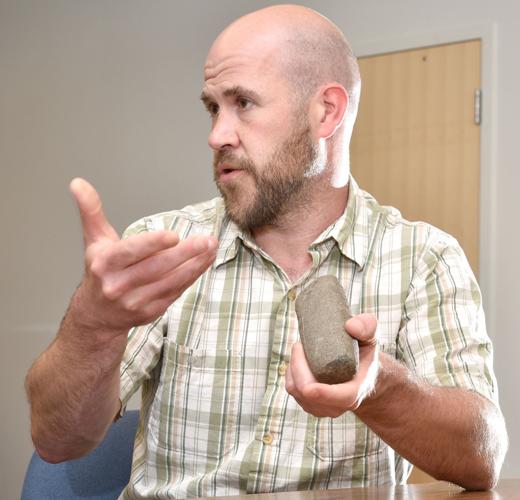
Tom Munson, Sioux City Public Museum archival clerk, talks about an American Indian celt -- a type of ax head -- at the museum's research center.
Celt -- A Native American tool or weapon that is about 3,500 years old. A local archaeologist and collector likely found this ax, club or hammer in a river valley or a creek bed along the Little Sioux River in eastern Woodbury County.

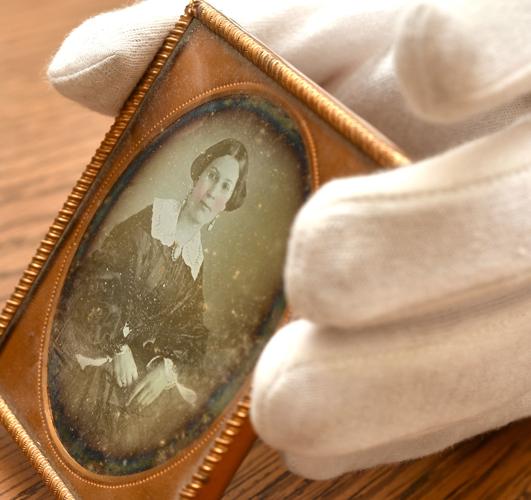
Tom Munson, Sioux City Public Museum archival clerk, displays a daguerreotype from Sioux City's Tackaberry family.
Daguerreotype -- This early form of a photograph was made between the 1840s and 1860s. The museum has a daguerreotype of a member of Sioux City's Tackaberry family, which ran a wholesale grocery company from 1878 to 1924.
1865 land partitioning -- Sioux City was platted in the winter of 1854 by Dr. John Cook. The museum has a document that divides the land that would become downtown Sioux City between Cook, James Jackson and Milton Tootle.

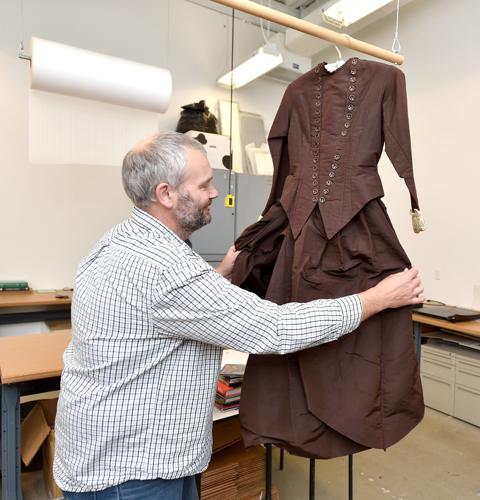
Matt Anderson, Sioux City Public Museum curator of history, displays a dress dating from the late 1700s.
1700s dress -- A two-piece dark brown faille dress features a jacket fitted with two pleated flaps and trimmed with two rows of metal buttons down the front. The sleeves have lace cuffs. The skirt has two overskirts. The museum received the dress in 1964 from Beatrice Viken, the wife of the late Andrew Viken, a boilermaker.
There are other artifacts at different locations throughout Sioux City.
13th CENTURY GRIFFIN
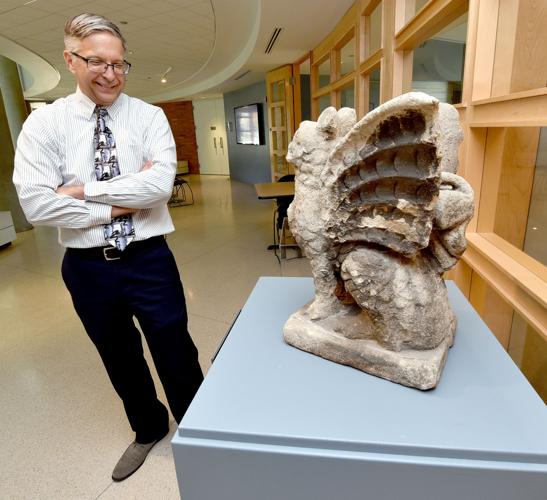
A sandstone griffin that once likely decorated the outside of a cathedral or large architectural building in Europe during the late Gothic period -- 1250 to 1275 -- is popular with children who visit the Sioux City Art Center.

Todd Behrens, Sioux City Art Center curator, talks about a circa 1250 stone griffin, the oldest item in the museum's collection.
The mythical creature with the body, tail and back legs of a lion and the head and wings of an eagle sits perched on a pedestal and encased in glass in front of the Community Gallery just feet from the visitor services desk where Beth Love works.
"They recognize that it's a griffin," she said of the Art Center's young visitors. "They think it's super cool and they wonder where it came from."
Time has worn away the griffin's face and one of its front paws. It's the oldest and most unique piece in the Art Center's collection.
"It beats everything in our collection by centuries," said curator Todd Behrens.
The griffin's exact origins are a mystery, according to Behrens. Before the Sioux City Art Center was established in 1938, the Sioux City Society of Fine Arts held exhibitions, lectures and classes throughout downtown Sioux City beginning in 1914. Behrens said the group began to amass an art collection. The griffin was one of the pieces in that collection.
"Most of the works that were donated through the society are late 19th, early 20th century paintings. This is the one truly unusual piece that came about," he said. "We don't know who it was from the community who had collected this and then turned it over to the Society."
1920s WAMPUS CAT PROPELLER
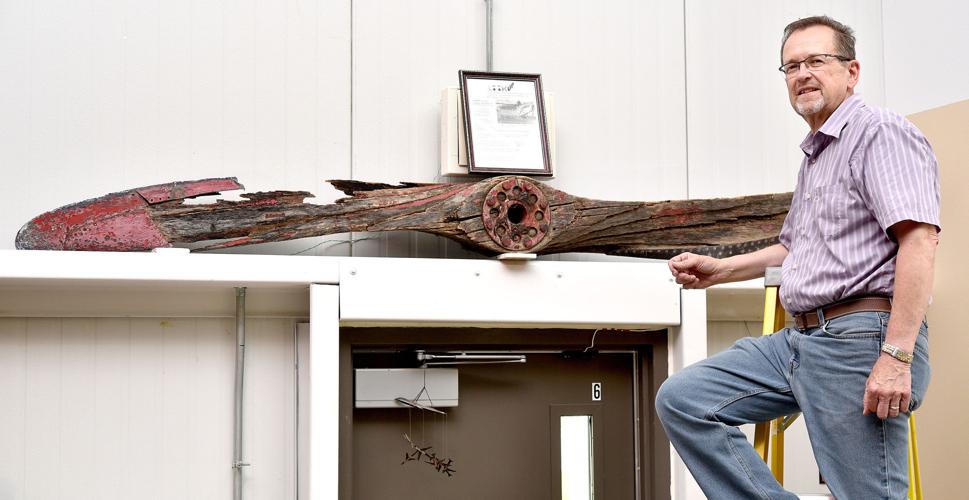
The oldest non-World War I piece of memorabilia on display at the Mid America Museum of Aviation & Transportation is a Wampus Cat propeller, which dates back to 1920.

Larry Finley, director of the Mid America Museum of Aviation & Transportation, poses with a Wampus Cat propeller from the 1920s that was found along the Big Sioux River.
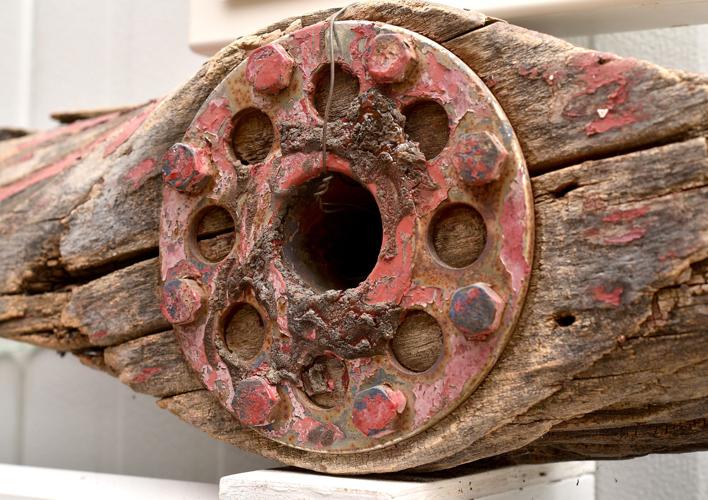
The propeller was found on the banks of the Big Sioux River years ago and donated to the museum. Executive director Larry Finley calls it a “rather unique” find.
The Wampus Cat, a rather strange craft, looks like a Curtiss JN-4D Jenny without wings. Powered by an OX-5 engine, the Wampus Cat floated in the water during warm weather. In the winter, it was equipped with skis to traverse ice. It could travel up to 30 miles per hour on skis and 10 miles per hour floating.
“The Wampus Cat itself was used out on the Big Sioux River between Iowa and South Dakota up until about 1923,” Finley said.
In 1923, when the old iron bridge that connected Riverside to what is now North Sioux City was replaced, the Wampus Cat was used as a ferry to get from one side to the other. It could hold up to six passengers.
Finley said he doesn’t know what happened to the actual body of the Wampus Cat that the propeller came from. Historical information provided to the museum states that when the Wampus Cat quit running it was dumped along the banks of the river.
1875 ATLAS
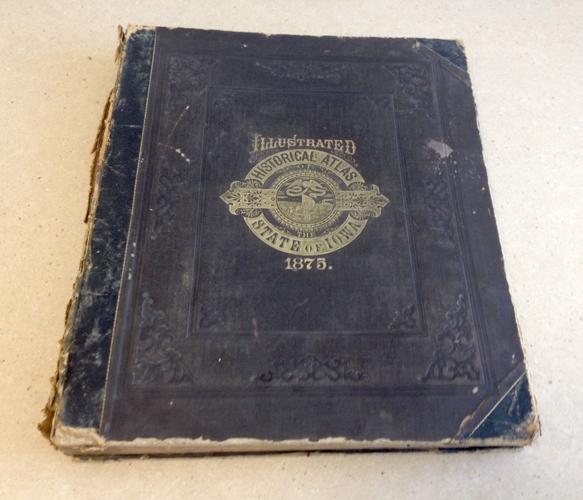
The Illustrated Atlas of the State of Iowa, which dates back to 1875, is the oldest book in the Sioux City Public Library's possession.

The Illustrated Atlas of the State of Iowa from 1875 is shown at the Wilbur Aalfs Library.
Although the atlas, which the library likely obtained by donation, is included in its catalog, Jessi Wakefield said no one has asked to look at the book during her first year as library historian.
"We do keep it locked in a different room that does have a little temperature control," she said. "They would have to ask if we had something like this."
But don't judge the book by its worn black cover.
The atlas contains 590 pages of detailed illustrations of places of interest in Iowa's 99 counties, biographical sketches of prominent government figures, an extensive appendix and maps of Iowa and the world. You can view a list of post offices, census data and life expectancy.
"Work was definitely put into this thing," Wakefield said, as she gently turned the atlas's yellowed pages on the Wilbur Aalfs Library's second floor.
The illustrations were done by A.T. Andreas. More than a thousand other people contributed to the atlas and their names take up many of its pages.