

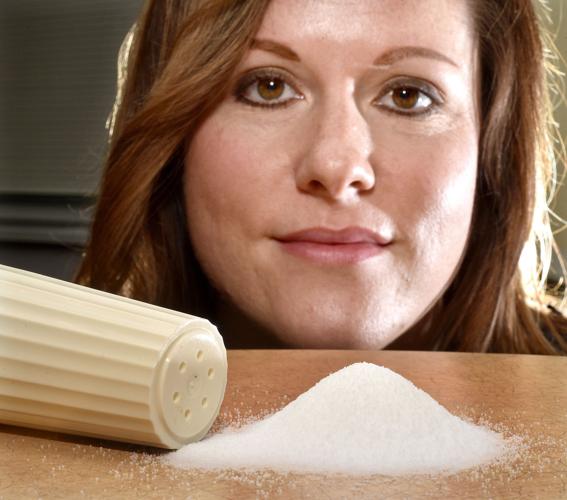
SIOUX CITY | Put down the salt shaker.
Chances are, like most Americans, you're consuming too much sodium or salt, a practice that's linked to high blood pressure, heart disease and stroke.
Allison Rossow, a registered dietitian at UnityPoint Health-St. Luke's, said some people salt their food before they even taste it. She said heavy salters who cut back on their sodium intake often complain their food doesn't take good anymore. She said people can find other ways to make their food tasty without salt.
Opt for fresh foods over processed foods. Chose garlic or onion powder instead of garlic or onion salt. Read labels to find canned foods with no salt added.
"Generally we recommend looking for sodium-free seasonings like Mrs. Dash," Rossow said. "They have Table Blends that you can put on meats and vegetables. They have seasoning packets for tacos, chile, fajitas and marinades. That's a good place to start."
People are also reading…
According to the U.S. Centers for Disease Control and Prevention, 90 percent of Americans consume too much sodium.
Average sodium intake in the United States is around 3,400 milligrams (mg) a day. Dietary guidelines released by the U.S. Department of Health and Human Services and the U.S. Department of Agriculture advise people to consume less than or equal to 2,300 mg (a teaspoon) of sodium per day, although our bodies need just 500 mg to carry out normal functions.
About 75 percent of total sodium intake comes from processed and commercially prepared foods. The U.S. Food and Drug Administration recently released new sodium guidelines for food companies in effort to get them to voluntarily reduce the amount of sodium they put in commercially processed, packaged and prepared foods.
The FDA's goal is to reduce average sodium consumption to 3,000 mg per day within two years and to 2,300 mg per day within eight years. Rossow said meeting the new guidelines might be challenging for manufacturers, but she said the change is doable and a step in the right direction.
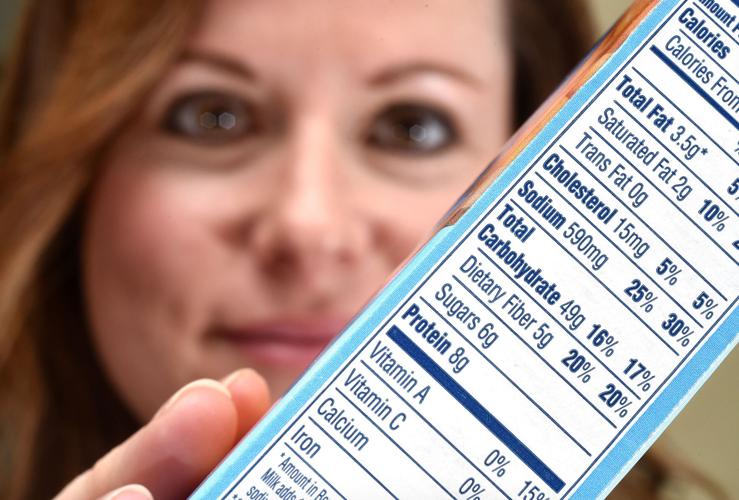
"A lot of patients I work with are surprised. They say, 'Well, I don't salt anything,'" she said. "People really need to be aware of those nutrition facts labels and then using that 2,300 mg as a reference point to make good choices."
Rossow uses a box of clear vials filled with sodium to show patients how various food compare. Three ounces of pork chop has dramatically less salt than the same amount of processed ham. Three ounces of ramen noodles beat out the ham and 14 baked potato chips.
"The majority of the sodium is in that seasoning packed," she said of the ramen noddles. "I tell patients, especially ones that live alone or are trying to eat on a budget, even if they can only use half of the seasoning packet or throw away the seasoning packet and use their Mrs. Dash and maybe add some vegetables it makes it a little bit more sodium-friendly and a little bit more balanced."
Rossow said reading labels can be confusing. She advises patients to first look at the serving size. She said a lot of people aren't aware that all the information on the nutrition facts label is for one serving. Any product that's labeled low in sodium has to have 140 mg of sodium or less.
"If they eat multiple servings, they're getting a lot more (sodium) than they think they are," she said. "If I'm looking at a product and it's got 1,500 mg per serving that makes it hard to fit in the rest of the day and meet that recommendation."
Restaurant food can be a huge hidden source of sodium, according to Rossow. For example, ordering a burrito bowl -- a seemingly healthy option -- at a popular Mexican-style restaurant chain typically contains more than 1,000 mg of sodium.
"That kind of makes it hard to meet that recommendation for the day if that meal has over half of the amount that you need for the day," she said. "If people can cook at home, that generally is a lot better because you can control all of those factors, where as if you eat out it makes it a lot harder."