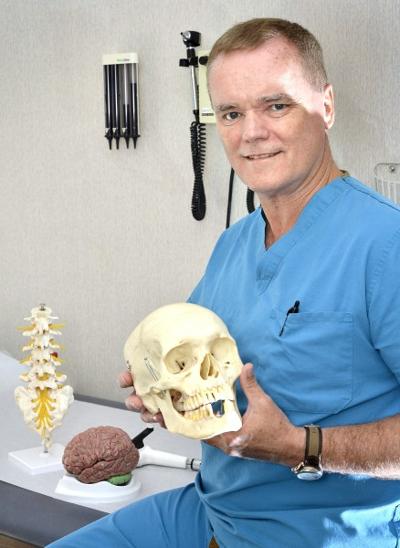

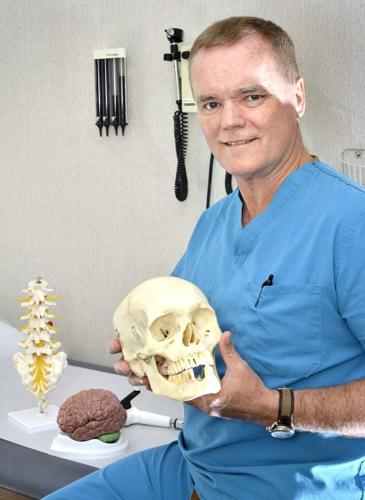
After Dr. Quentin Durward completed his neurosurgical residency in Canada, he meant to go back to New Zealand. He became an assistant professor of surgery at Dartmouth Medical School instead.
It was something he thought he would do for a short time and, then, return to his native land.
He got one right.
He taught for less than four years. But afterward, he didn’t move anywhere near his hometown of Rotorua.
He came to Sioux City, another place he didn’t intend to stay. He’s been a neurosurgeon in Siouxland since 1987.
And he’s not going anywhere.
“It takes a long time to lose that longing that you’re not home,” he said. “But now, if I lived in New Zealand, I’d long to be back here. Because this is home.”
People are also reading…
Yes, he’s settled in.
By nine o’clock on a Thursday morning, the 59-year-old neurosurgeon sat comfortably in his Dakota Dunes office at CNOS, chatting on the phone in between surgeries.
He had already completed a spine operation a couple hours earlier.
One down, three to go.
Durward had a surgery scheduled to treat a clogged artery and two brain operations planned in the afternoon.
“That’s a typical surgery day,” he said. “I see patients in the clinic two days a week, and I operate three days a week.”
With a total of six neurosurgeons now on staff at CNOS, Durward is on call about every sixth night.
That’s nothing compared to the hectic schedule he kept years ago when he was the only neurosurgeon in the city.
“I had to be on call 24 hours a day,” he said. “This huge amount of my life was spent at the hospital and being available every day and every night.
“That was really a tough time.”
But he made a commitment to being a surgeon, and he stuck with it.
From his desk, Durward pointed at two black-and-white photographs sitting on a bookshelf.
“See those two pictures? Those are two very famous doctors,” he said.
The one on the left shows Dr. Charles Drake, who was the chief of neurosurgery at the University of Western Ontario when Durward was training there. Drake pioneered a surgical procedure to correct aneurysms at the base of the brain.
The other man is Dr. Henry Barnett, who led a study that demonstrated aspirin could prevent stroke. He, too, was at the university hospital during Durward’s residency.
He doesn’t have a framed photograph of the third man, but it was Dr. George Prioleau, the chief resident in neurosurgery at San Francisco General Hospital in New Zealand, who he says influenced him more than anyone.
“For a young surgeon in training, he was extraordinarily proficient, made me work extremely hard to keep up with him, but he was also very kind to me and really taught me confidence at a very young age in being able to do surgery.
“I gained a certainty in San Francisco that I was going to be a neurosurgeon, come what may,” he said.
Throughout medical school, he was fascinated with anatomy and found that he really enjoyed surgery, being able to work with his hands.
His profession comes with pitfalls.
“The hardest part of the job is that many conditions we have to deal with are devastating,” he said. “And even with our best efforts, people can suffer terrible neurological consequences.”
For example, a blood clot from a head trauma can be removed to relieve pressure on the brain, but often, the initial injury results in a degree of underlying permanent brain damage.
Or, if someone fractures his or her spine, a neurosurgeon can take pressure off the nerve tissue and fix the fracture, but permanent injury has likely occurred to part of the nervous system.
“Oftentimes, they can make a substantial improvement and sometimes a complete recovery, but we do have people, who even after the most extensive care, live with a permanent paralysis.
“That’s very, very hard to take for everybody.”
In the wake of trauma and tragedy, he perseveres.
“The important thing in neurosurgery is, at the end of the day, that you feel that you’ve given your best effort and the result of your treatment has been well thought-out and the patient has received a care, which when you look at it, you don’t think could have been done better anywhere else,” he said.
“That’s the most satisfaction I get.”