

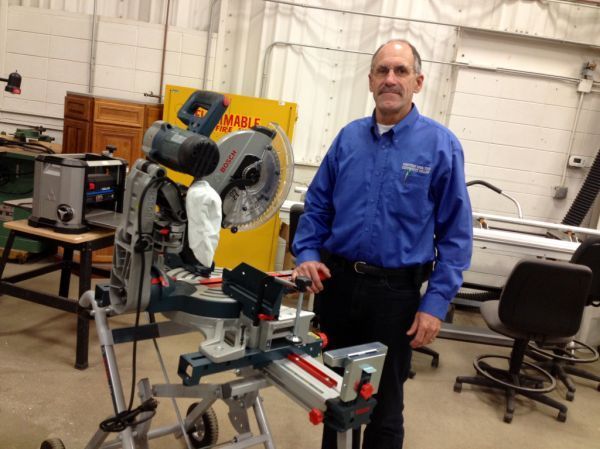
Bob Wilcke graduated from Western Iowa Tech Community College's construction program 40 years ago. For the past 16 years he's been teaching students at WITCC how to build homes. Wilcke answers 20 questions about what he's teaching students today, what the current construction marketplace looks like and what people looking to build a home need to know.
1. Did you build houses?
A few. Most remodel and repair. I lived in a very agricultural area around Battle Creek, Iowa, so there wasn't a lot of new housing going on. It was mostly agricultural buildings and remolding houses.
2. Why did you make the move to eduction?
That was kind of my second love. ... In 1996 I had the opportunity to teach down at Dension in a high school class through Western Iowa Tech. I kind of took a leap of faith. I drove to Denison which was 35 miles each way to teach for an hour and a half. I knew it could potentially lead to something bigger.
People are also reading…
3. What are students in the construction program at Western Iowa Tech learning?
Our program is pretty much what we call a residential program, which is housebuilding. Our curriculum follows the progression of building a house from start to finish.
4. Do they work on a project home?
We have a project home that they build each year. They learn virtually every phase of the construction as far as the carpenter's side. Our electrician students come and do the electrical wiring.
5. What jobs can students expect to get when they graduate?
The world keeps getting more and more open all the time. Since September I have probably had between 30 and 40 job opportunities come across my desk. They range from being a field salesman to lumber yards from a distributor point of view. I've had areas in Sioux Falls, S.D., that are looking for carpenters in precast concrete in making truss rafters. I have residential carpenters that want workers. My students would qualify for any of these jobs.
6. What are the occupational risks associated with construction work?
It's among the most dangerous occupations. OSHA has a general industry standard and they have a construction standard. It is a dangerous occupation. Old contractors have worn out knees, sore shoulders and bad backs. It is very wearing on the body.
7. What are the rewards?
There's nothing like being able to drive down the street and say, 'I built that house.' What I just love for my students to do the last day we're at the project house is to walk away and then I invite them back for an open house on graduation day. When they walked off it was a worksite. When they come back, it's a home. It's the same building. Hardly anything was done. Maybe carpet was put in, but it changes. It was a place we got dirty and worked and now suddenly somebody's place to call home and to enjoy a family.
8. Is now a good time to build a home?
It's always a good time to build a home if your marriage can withstand it. Probably the sooner the better. Demand is increasing. Housing is up, which is going to drive prices up. At this point the future points to housing continuing to be strong for the next few years.
9. Is the construction industry facing a shortage of workers in the future as the welding and electrical industries are?
We don't have enough workers in the industry. The last time I looked on the Department of Labor's website about a year ago, they projected by 2022 we will need another 22 percent of construction workers and in that same time probably around 22 to 25 percent of current workers are going to be retiring. The 15 community colleges in Iowa can't supply enough workers to keep up with the new demand much less retirees.
10. What are the requirements for a construction major?
Our program here is a shorter course than most of the community colleges in Iowa or in the area. A lot of them are two-year programs. Ours is just a two semester program. It's really a fast track but we get a huge amount of material into it. We teach all phases of building a house. We don't get into some of the specialty things like cabinet building. We don't do carpet laying. We do some other types of flooring. We don't do a lot of the management or supervision-type things that some programs might do.
11. Do students have to have any prior experience in building before they enter the program?
We come in with the assumption that they don't have any background. Actually the trend is that I have more and more students that don't have a background. My student population has changed over the years from a very traditional clientele to very non-traditional and very diverse.
12. Are you class sizes growing?
Yes. I have 17 students currently. For as long as we had the program with one instructor, the cap was 18 students. The last couple of years we have expanded that cap to more than 18.
13. What's a question that students frequently ask you?
Probably if they can get a job or what kind of job they can get.
14. How do you choose a contractor?
I'm the past president of the Home Builder's Association and I have bias toward looking at professional organizations as far as references and reputation. In rural areas and even Sioux City, word of mouth is much more powerful than glamorous advertisement. Talk to you neighbors. Talk to people. Stop at a job site that somebody's working on talk to the contractor that's working.
15. Are house better built today than they were in the past?
Yes, for the most part. Sometimes we get in a hurry. There are contractors that just go too fast. Sometimes the quality is a drawback. I think with the green building agenda and energy efficiency and all of those things that our customers are demanding, there has to be a better quality to it.
16. Are there regional differences in home construction, building economies?
Right now I think Sioux City or the Upper Midwest is probably the hotspot of the nation, actually. I have one student from last year that's in San Diego. Typically the work ethic of the Midwest is very marketable throughout the country. The majority of my students don't want to leave. That becomes a little bit of a challenge.
17. Sioux City has a lot of older homes. Is there a market for new homes?
The permits that have been pulled the last year and half have been at a very fast pace. I don't think we've had record years as far as new home construction, but it's been very, very good considering what it was in 2008, 2009. You see that city council struggling with it as well -- whether they save these older homes. Just the geographical way that Sioux City lays, it's kind of hard to find places for mid-range homes.
18. What are some telltale signs a home isn't constructed properly?
Probably some of the biggest issues in homes these days are with moisture as far as whether the insulation is done properly, whether the ventilation is done properly and that comes all under the building science. Sometimes if the building contractor doesn't communicate with the plumbing and the HVAC, holes can come and problems can happen. We have a reputation with my students of building a very tight house. That can lead to some moisture problems if you don't run your bath fans.
19. What are some mistakes people make when picking a contractor to build their home?
There's a misconception that it's a lot quicker and easier than what you'd think. There's no substitute for planning ahead. Most of the headaches that a contractor would have are changes that happen too late in the game. It causes you to go back and tear a wall out or change the size of a window or move a door over. When you look at blueprint, put your furniture in there. Look at your traffic flows. What I like to do when I'm building is visit with my families before we draw up anything and just find out what their lifestyle is and what their needs are.
20. Did you build your home?
The house I'm in now, no. The one I had previously, I did built it. I finished it in 99' and lived in it until 2011.