


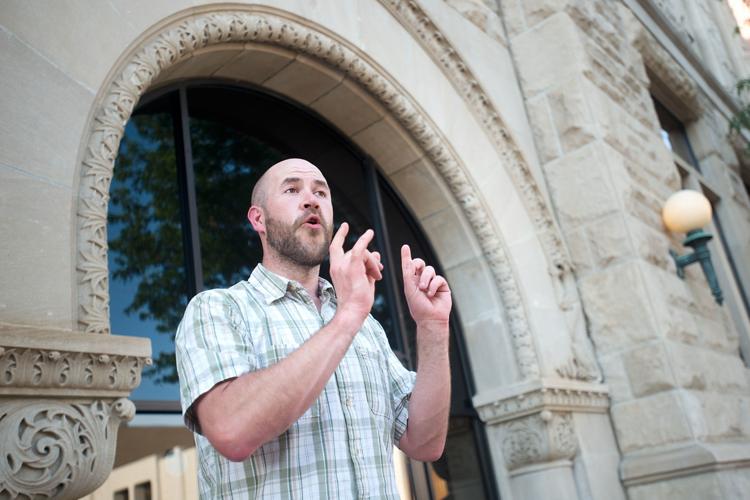
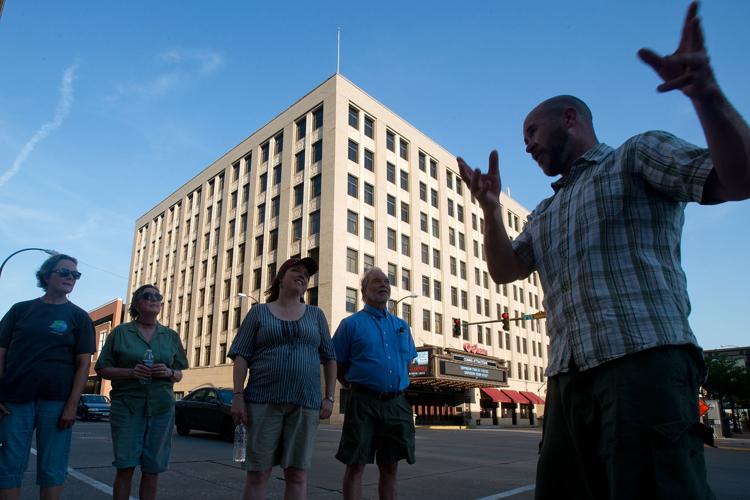


SIOUX CITY | On a 94-degree day in June, six history buffs gather outside the Sioux City Public Museum waiting for the downtown walking tour to begin. They point to a white building across the street, asking, “What’s that? Is that the Williges Building?” There’s a sign on a street-level window that says Century Plaza Apartments.
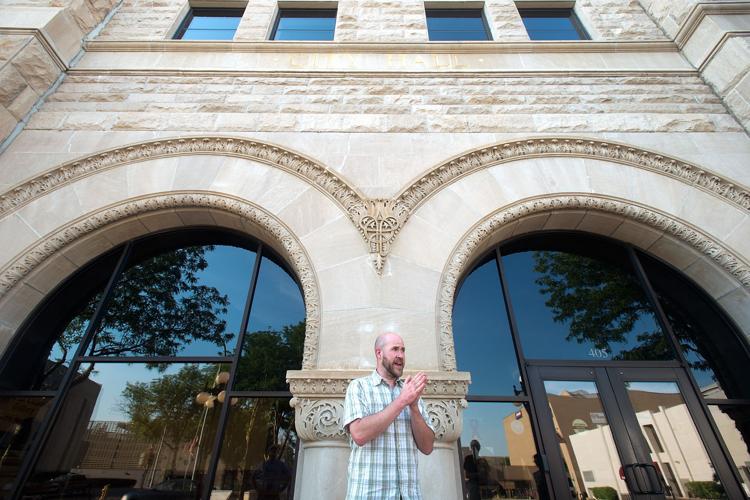
Like a walking encyclopedia, Tom Munson rattles off the facts.
It was built in 1902 as an annex to the T.S. Martin Department Store.
“This was the home of their mail-order business,” Munson says. “What is special about this building, in addition to having lasted 114 years, it is a pretty rare style of architecture in the city’s history.”
The latest walking tour put on by the Sioux City Public Museum catches the attention of Ted and Susie Rudberg, who live in a rural Dakota County home listed on the National Register of Historic Places. Her great uncle built the farmhouse in the early 1880s, and her mother’s 99-year-old cousin was the last family member to live there.
People are also reading…
The house went up for auction. Other bidders would have bulldozed it, so the Rudbergs moved from Arizona to Nebraska to save the family farm. They bought the property in 2006, committed to making the necessary renovations in their retirement.
To say they have an appreciation for historic preservation would be an understatement.
It was their first time going on a guided walking tour with Munson, the archival clerk for the Sioux City Public Museum's research center. They’ve picked up the brochures to go on independent tours, but instead of reading a blurb about each building, they get the full scoop.
Walking a block north of the museum, up to 520 Nebraska St., Munson launches into another history lesson.
“I have given modified versions of this tour to groups of 9- to 11-year-olds,” he says. “I love to play this joke on them. The building behind me, raise your hand if you think you know the name of this building?”
A man calls out, “Motor Mart.”
The kids usually say “Commerce Building” because it’s written in bold white letters on the green awning down below. But if you look up to the tippy-top, Motor Mart is engraved in stone, calling back to an earlier era.
Built in 1912 for Ralph Bennett’s automobile dealership, the four-story building was outfitted with a 10-by-20-foot elevator, designed to hoist automobiles from floor to floor. Bennett sold Moon and White automobiles.
“They didn’t do so well. Neither did he,” Munson says. “In 1919, the chamber of commerce moved into this building. That’s why it is called the Commerce Building.”
A fifth floor was added in 1921 and housed Tom Archer’s Roof Garden. It later became a music hall and dance club called the Skylon Ballroom. Lawrence Welk and his band performed there in 1939 before he signed with Decca.
Someone asks, “Anything going on in the ballroom these days?”
“I haven’t heard much,” Munson says.
“Is it pretty well rented out?”
“This building is actually pretty full.”
The group moseys along Sixth and Douglas streets, stopping outside the War Hotel, city hall, the federal building, municipal auditorium, Woodbury County Courthouse and the Warnock Building, another former auto mart.
With all the questions from his small band of followers, Munson’s walking tour goes 30 minutes beyond the hour.


