


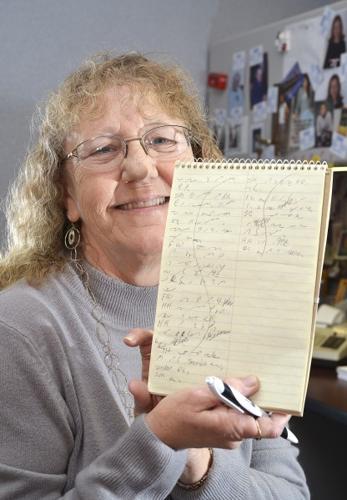
In this age of computers, many may consider the skill of taking shorthand a dying art.
Marge Hollingshead, a technical clerk with the City of Sioux City for 37 years, would disagree.
"It has many strengths," she said. "I take messages for people, take minutes for meetings and/or writing something down at home. I used to make my Christmas lists out for my sons in shorthand. Never had to worry about them finding out what they were getting."
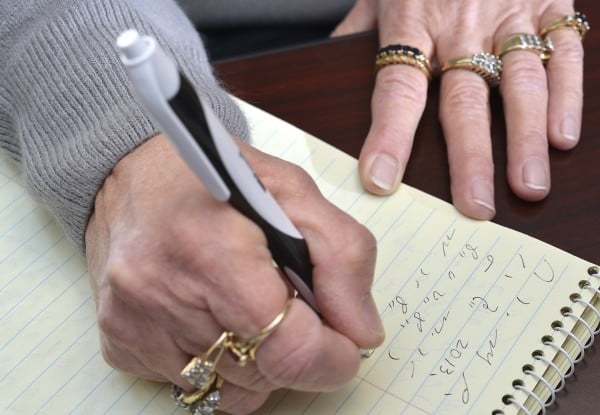
Once a popular course in high school for those considering a secretarial career, shorthand takers are fading away with only a few remaining to capture their squiggles on paper, which to the unschooled may look like a combination of hieroglyphics, the Russian alphabet or Chinese characters.
"At the time, being a secretary was very prestigious and I knew I didn't want to be a nurse, teacher or go to a four-year college," Hollingshead recalled. "I think I always wanted to be a secretary."
People are also reading…
Hollingshead learned shorthand in high school, back when there were mimeograph machines, manual typewriters and carbon paper.
"I took it for four years at Humboldt High school," the 1968 graduate said. "After graduation, I attended Spencer School of Business for a year, graduating in 1969."
Shorthand is an abbreviated symbolic writing method that increases one's speed of writing or transcription. A typical shorthand system allows one to write as quickly as others speak. The only tools needed are a pencil and a steno pad.
Before the invention of recording and dictation machines and computers, shorthand was used widely in the business field where written transcripts could be important as a means of recalling exactly what was said and by whom.
The most popular form -- the one Hollingshead learned -- was Gregg Shorthand, a form of speed writing using written strokes created from the alphabet. Each written stroke, consisting of lines, curvy lines, loops and dots, in combination with each other represent sounds that combined with each other create the words.
Hollingshead started using shorthand at her first job.
"During my junior and senior years in high school, I was a member of OE -- Office Education and held a parttime job after school for a real estate broker," she said. "It gave me credits for the class and also the opportunity to embellish my shorthand skills."
There were surprises even for Hollingshead who had several years of shorthand under her pad.
"What surprised me from learning it to implementing it was not everybody talked as slow as the instructor in class and sometimes it was a real trick trying to keep up with who was dictating," she said. "On the other hand, it helped to improve the speed in which you could take shorthand."
One of the biggest challenges, even for an accomplished shorthand taker like Hollingshead, is being able to transcribe shorthand notes exactly, or close enough.
"Sometimes things have to be put down verbatim, which isn't easy if you aren't sure what the person is exactly talking about," she said. "Then, there are meetings where more than one person is talking at a time. You have to decide which is the most important and hope you picked the right one."
Over the years, Hollingshead has adapted her Gregg Shorthand to fit her needs.
"I have basically created a lot of my own signs/symbols for certain things," she confided. "A big secret of taking shorthand is memory. You have to remember what was being discussed and remember what a certain sign/symbol might mean in transcribing."
In her job with the city, Hollingshead takes minutes for the Board of Building and Housing Code which meets every three months.
"We also have a DRC (Development Review Committee) that meets usually once a week that I take minutes for," she said. "I also take down messages and/or notes for the inspectors in shorthand. Of course, I have to transcribe them for the inspectors since none of them can read shorthand, especially mine."
Even with the current dearth of shorthand takers, Hollingshead felt it is a rewarding asset to have.
"A person can become quite proficient in taking shorthand and go a long way with it," she said. "I have found through the years that it is a great help when you have somebody on the phone rambling about something, you can take everything, most everything, down in shorthand and then transcribe it. Personally, I think it should be brought back into today's society."
Just kind of a self satisfaction that I do know a dying art and


