
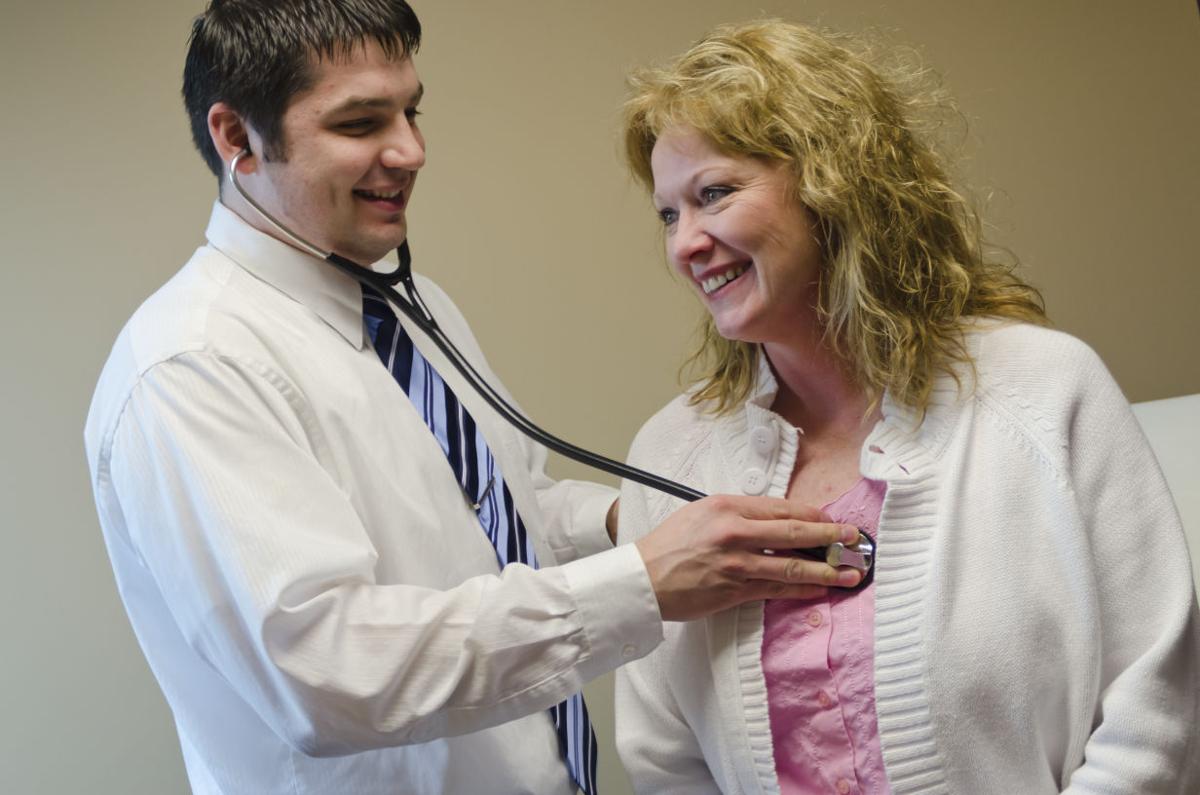
SIOUX CITY | Chris Jacobs realizes the language barrier that exists between him and his patient the minute she begins to speak.
She isn’t fluent in English. Jacobs doesn’t speak much Spanish — at least not yet.
Luckily, at the Siouxland Community Health Center where he practices, on-site interpreters are on hand to translate.
“We see a variety of patients who speak a foreign language,” says Jacobs, an advanced registered nurse practitioner at the SCHC. “Even with interpreters, the opportunity for me to become more fluent in Spanish would be a great benefit to our patients and my overall practice.”
That’s part of the idea behind Briar Cliff University’s new “FRANCIS Project,” a collaborative initiative between BCU and local health care providers, aimed at providing better primary care in the region for those who need it most.
People are also reading…
This fall through the FRANCIS project, Briar Cliff will begin to offer a “Spanish for Health Care Professionals” course for clinicians like Jacobs who are already practicing in the field.
“You can go online and get a language course anywhere,” says Susan Beidler, associate professor and department chair of nursing at Briar Cliff. “But this course is going to be delivered specifically as it relates to knowing the language in a health care setting.”
Research says that language barriers in health care can increase the risk of medical errors and decrease patient satisfaction. But it also says that clinicians can improve their patients’ experience by learning about different languages and cultures.
“We tend to think about ‘progress’ being defined as new technology — but technology isn’t what increases the health status of under-served populations,” Beidler says. “That only happens when patients have good relationships with providers, and are able to communicate with them.”
Siouxland isn’t just facing a lack of health care providers who speak Spanish, though.
The U.S. Health Resources and Services Administration also classifies Woodbury County as having a shortage of primary care providers in general. (Other counties on that list include Buena Vista, Ida, Lyon, Monona, Plymouth, Sac and Sioux.)
And Siouxland isn’t alone in the physician shortage crisis.
“There’s a shortage of physicians and primary care providers not only in Siouxland, but also around the country,” Jacobs says. “And the shortage is only expected to increase as time goes on.”
More and more, hospitals and clinics are looking to nurse practitioners to close the gap.
Briar Cliff is educating those nurse practitioners through its Master of Science in Nursing (MSN) and Doctor of Nursing Practice (DNP) programs — the only accredited graduate nursing programs in Sioux City.
“Our primary focus is channeling the resources of our graduate nursing programs to develop professional nurse leaders and to provide the best possible health care to people in our region,” Beidler says.
Now, 50 years after the nurse practitioner role was first conceptualized, today’s advanced registered nurse practitioners (ARNPs) are taking on roles that everyday doctors used to: They diagnose illness. They discuss treatment plans and prescribe medications. In Iowa and Nebraska, they can even practice autonomously without the oversight of a doctor.
“We never want to say ‘replacing physicians,’ because that’s just not accurate or our goal,” Beidler says. “It’s about meeting needs and providing services where other providers are not available and where people are not being served, and about enhancing care in support of physicians where they are.”
There are plenty of needs to meet. As baby boomers age, the Affordable Care Act expands and more physicians retire, the physician shortage crisis is only expected to worsen. And fewer medical school graduates are selecting primary care, choosing instead to specialize.
The shortage has hit certain populations harder in Siouxland; particularly among what Beidler classifies as “under-served populations” — minorities, immigrants, rural and lower-income patients.
“They often don’t have the same access to services and don’t have the same health outcomes,” Beidler says. “So we need to train a workforce that is better equipped to care for these people.”
That’s one of the reasons you’ll find Briar Cliff graduate nursing students being trained in rural and under-served clinical settings across Siouxland.
Take the Siouxland Community Health Center, for example, where Jacobs — himself a 2007 graduate of Briar Cliff’s MSN program — now serves as clinical preceptor to mentor other BCU grad students.
“It’s one thing to read about a disease process or procedure, and another thing entirely to see it done on an actual person,” Jacobs says. “So this is a great benefit for students, but it also helps current providers improve our own practices. It challenges you to be current on most recent recommendations.”
Through the FRANCIS Project, Briar Cliff is also expanding existing partnerships and clinical opportunities with the Siouxland District Health Department, the Omaha Tribe’s Carl T. Curtis Health Education Center in Macy, Neb., and at critical access hospitals and rural health clinics across Siouxland.
FRANCIS is an acronym for “Forging Relationships for Advanced Nursing Cultural Competency in Siouxland,” a nod to Briar Cliff’s Catholic, Franciscan heritage. Funding for the project comes from a half million-dollar Advanced Nursing Education grant that was awarded to the university last year.