


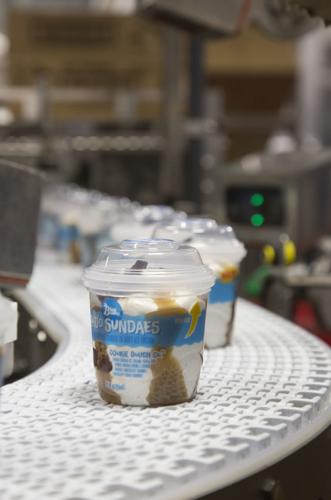
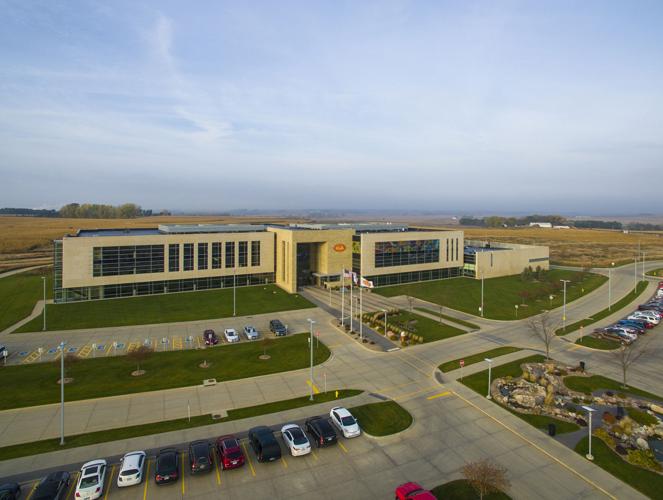
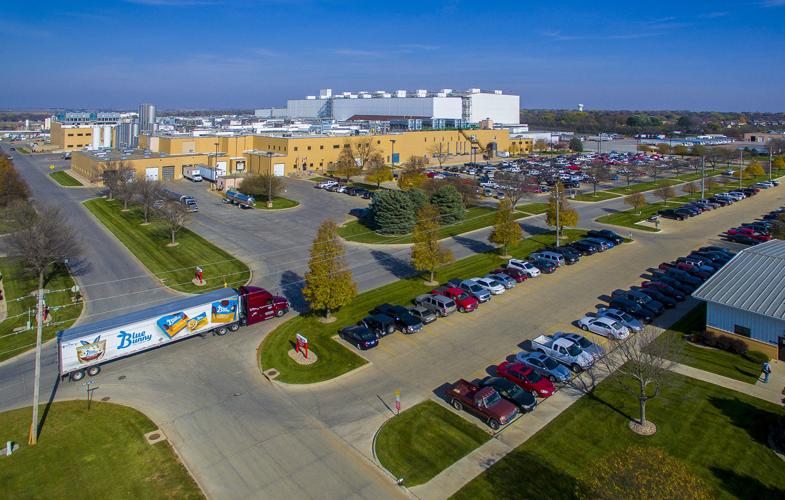
LE MARS, Iowa -- Wells Enterprises became a lot bigger in 2019.
The Le Mars-based ice cream maker's trio of major acquisitions last year rocketed the firm to the nation's second-largest ice cream maker, and positions the company for expanded production, the Le Mars-based company's top official says.
In 2019, Wells purchased Fieldbrook Foods, an East Coast ice cream maker, followed by a Nevada plant purchased from rival Unilever and then Halo Top, a low-sugar, high-protein brand of ice cream.
People are also reading…
The Fieldbrook purchase alone boosted Wells' capacity to nearly 200 million gallons, bolstered further by the Unilever and Halo Top acquisitions. Wells now operates plants as far away as Lakewood, New Jersey, Dunkirk, New York and Henderson, Nevada.

Mike Wells
President and CEO Mike Wells said that prior to the acquisitions, the company's two plants in Le Mars were operating at around full capacity, with little opportunity to boost production any further.
"We were full," Wells said in a phone interview in February. "We were two lines away from having every inch of capacity utilized."
"The biggest thing that we're in a position to do today that we haven't been in the past is, we now have capacity to grow. A year ago, without the acquisitions, we were at capacity. Today, we can use the excess capacity in total to find ways to grow."
The acquisition expanded the company's employment rolls 25 percent, from around 3,000 employees to 4,000 today. The company is still hiring.
Recently, Wells signed a licensing agreement with the popular restaurant chain Cheesecake Factory to produce an ice cream version of cheesecake, made with real cream cheese and sour cream. The purchase of low-calorie ice cream brand Halo Top, meanwhile, enables Wells to provide "products that are a little bit outside of the core of traditional ice cream, but are providing a real need."
"We grew our top-line business by over 30 percent, in the combination of those acquisitions, which strategically positions us to be the number two producer of ice cream in the United States today," Wells said. "It's been a nice way to augment what we do here in Le Mars, but yet, we're busier in Le Mars today than we ever have been."
Wage increases
Mike Wells is also a member of the Iowa Business Council, a nonpartisan group whose members represent some of the biggest employers in the state. The IBC recently released its annual Competitive Dashboard, a measure of the state's performance in terms of business metrics.
The main trouble faced by Iowa companies in 2019 was employees -- they just couldn't find enough workers.
"In this corner of the state, there are just a lot of blue-collar production jobs that need to be filled, and that does create a particular challenge, at least for us in Northwest Iowa," Wells said.
The state remains at full employment this year; Woodbury County's unemployment rate was pegged at 3 percent as of December. Because of the worker shortage, businesses have had to boost wages and benefits -- the state's median household income rose almost $1,400 last year to $59,955, according to the Competitive Dashboard report.
Wells is among the firms that have upped employees' pay, and they've become more creative in their efforts to accommodate employees. Wells has partnered with local governments and developers to build affordable housing units for its workers, and they offer busing for employees who need transportation to work.
"A year ago, I would have told you that we can't find enough people to fill the jobs. Today, I would tell you that we're not having trouble finding enough people to fill out applications, and our retention rates have actually gone up considerably," Wells said. "We think a big part of that is, we continue to adjust and pay more than competitive pay rates."