

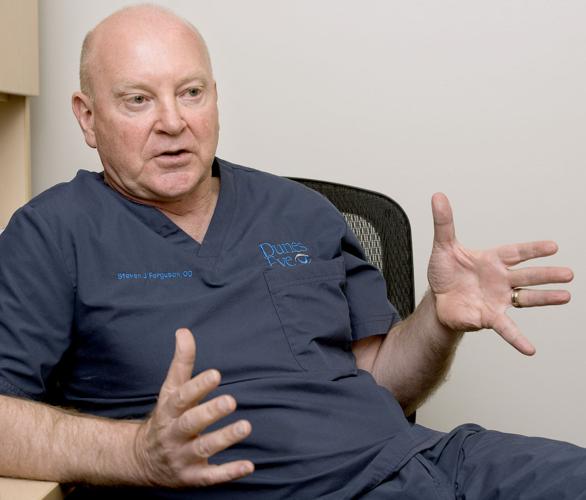

DAKOTA DUNES — Dr. Steve Ferguson’s personal battle with dry eye disease inspired him to launch a specialty clinic for the condition at his Dakota Dunes-based practice.
“Dry eye is the No. 1 medical eye diagnosis for eye doctors in the world; it’s the most frequently encountered problem,” said Ferguson, who had previously traveled across the country to find dry eye specialists.
Ferguson is the founder and lead physician at Dunes Eye Consultants, a 15-year-old enterprise he started to provide people with an elevated level of eye care.
The 12,000-square-foot medical service center provides traditional eye care services as well as specialized treatment services for diabetes, glaucoma, myopia headache management/neuro vision therapy and Lasik.
However, for nearly four years now, the clinic has garnered a national reputation for its treatment of dry eye, which impacts millions of Americans, according to the National Eye Institute.
People are also reading…
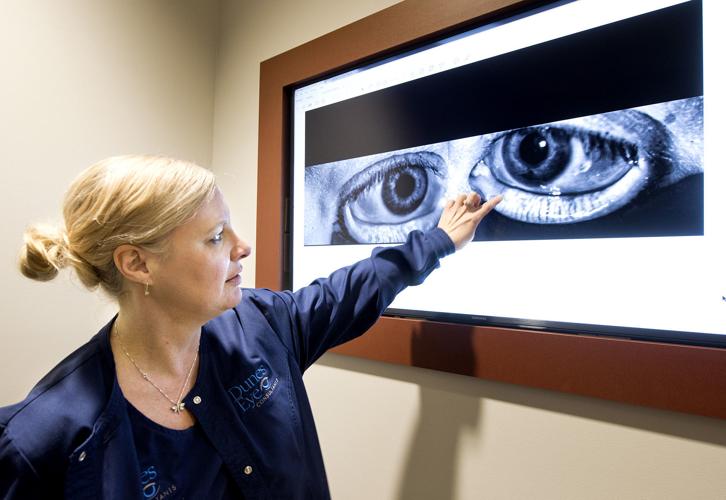
According to Ferguson, dry eye is an abnormality of the tear duct that can lead to surface disease on the eye.
“That can be caused by lots of different factors,” he said. “Meibomian gland disease is present in 85 percent of all patients who have abnormal tears from dry eye.”
Meibomian gland disease (MGD) is caused by chronic exposure to evaporative stress. Some examples that can cause evaporative stress are low humidity and/or high-airflow environments, wearing contact lenses and starting at digital screens, which suppresses blinking.
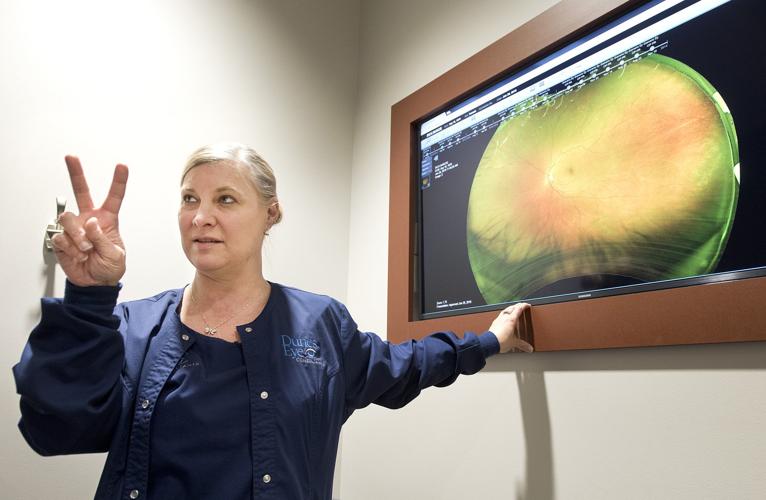
Chronic exposure to evaporative stress accelerates the aging of the meibomian glands as healthy oils housed there begin to thicken and block the glands. If they remain blocked for too long, the glands stop producing oil and they begin to atrophy and disappear.
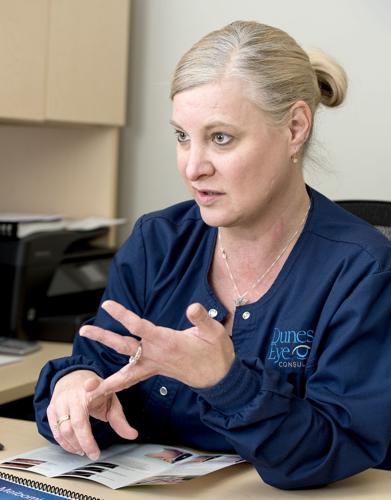
Ferguson and Marcie Rich, a dry eye specialist at Dunes Eye Consultants, both have MGD, which is why they are so passionate about helping treat the condition.
“You can't teach empathy and when you've experienced it; it gets to the point where it runs your life,” Rich said. "I didn't even want to get out of bed on the weekends because I was so miserable."
Some of the symptoms Rich experienced were severe read eye and fluctuation of vision in addition to severe dryness.
"It felt like my eyes were thrown down a dirt road all the time," she said.
Ferguson launched the Dry Eye Specialty Clinic at the practice in 2014, shortly before he became the first person in South Dakota to undergo the treatment.
Based on his personal and professional research, Ferguson determined the most effective treatment for MGD is LipiFlow, a 12-minute procedure that’s proven to be effective against the disease.
“We’re the first center in South Dakota to offer LipiFlow,” Ferguson said.
During a LipiFlow procedure, a medical professional applies a heated instrument directly on the inner surface of the eyelids where it gently compresses and causes the congealed oils to reactivate.
An analogy Rich uses to help people better understand the procedure involves her grandmother cooking baking on the stove.
She said her grandmother would cook bacon store the leftover grease on the side of the stove in a container where it eventually solidified.
When her grandfather wanted fried potatoes, he would scoop out hardened bacon grease, throw it in a skillet and it would return to its liquid form after being heated up.
"That's kind of what LipiFlow first does," Rich said.
Ferguson noted something he found interesting about LipiFlow is that treatment can last for years at a time before it needs to be done again.
“We are so impressed with the long-term benefits that patients have been able to go three years so far with only one treatment,” he said.
“We anticipated patients would need to be treated more often than this and I think we got some really good adjunct therapies and I think our experience has really helped us.”
Ferguson said the clinic is approaching its 1,000th LipiFlow procedure and people have come from much farther than Siouxland to receive this treatment.
“People are searching for us. They’re coming from long distances to come to us to help them find a solution,” he said.
“The problem is that patients come to us, usually, in late stage disease and they are the most difficult to treat and it’s best treated at an earlier stage.”