

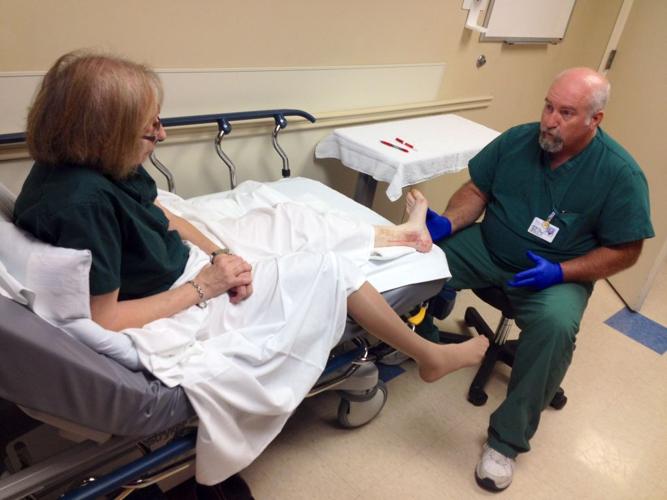
SIOUX CITY | Myra Wessel developed an ulcer on her left ankle in January 2014. The wound, which was about the size of a half dollar, wouldn't heal.
The 66-year-old, who thought the ulcer was caused by running shoes, sought treatment in her hometown of Ida Grove, Iowa.
The wound began to yellow and increase in odor and pain. Eight months later, Wessels asked to be referred to Mercy's Advanced Wound Care Center in Sioux City.
"It wasn't getting better," said Wessel, who works as a manager at Bomgaars.
Wessel underwent some tests at the Wound Care Center before going to Mercy Heart Center, where staff evaluated the arteries in her legs.
"I never had anybody check that stuff out before," she said. "It's a good thing they did."
Wessel wasn't getting enough oxygenated blood, which is pushed with each heartbeat through the arteries to all areas of the body, to her left ankle.
People are also reading…
"If we were to take the foot and ankle and divide it into zones, there's six different zones for perfusion," Michael Garrett, a nurse practitioner who treated Wessel at the Wound Care Center, explained. "Her one zone where her ankle was showed no oxygen at the skin surface."
This condition is called peripheral arterial disease (PAD), which is the narrowing or blockage of the vessels that carry blood from the heart to the lower extremities. It's caused by atherosclerosis, fatty plaque build-up in the arteries, and is most common in the arms and the legs.
Some 8 million people in the United States have PAD, according to the Centers for Disease Control and Prevention, including 12 to 20 percent of people over age 60.
People who smoke, are older than age 65, have diabetes, high blood pressure, high cholesterol and or atherosclerosis, are at risk for developing PAD. The chances of men and women developing PAD increases as they age. The only risk factor for PAD Wessel had was her age.
Providers originally thought Wessel's ulcer wasn't healing because her lower legs were swelling. This made sense since Wessel is on her feet while she works.
"If you don't look for it, you'll never know that it's there," Garrett said of PAD. "A lot of people figure it's something else."
Wessel was prescribed antibiotics to treat a staff infection in her ankle. The ulcer had three individual holes tunneling underneath that connected beneath her skin. She visited the Wound Center twice a week to have her ulcer cleaned and dressed. She said Garrett told her she was lucky the infection hadn't spread to the bone.
After some time, Wessel noticed the wound slowly starting to heal. She read an article about the Wound Care Center's hyperbaric chamber. She asked Garrett if hyperbaric oxygen therapy would benefit her condition.
Hyperbaric oxygen therapy (HBOT) is a medical treatment in which patients breathe 100 percent oxygen while under pressure in a hyperbaric chamber. The atmosphere in a hyperbaric chamber allows more oxygen to dissolve into the blood, which is then delivered to areas that are struggling to heal.
After Garrett got the OK from Wessel's health insurance provider, she started making the hour-plus drive from her home to Sioux City five times a week to receive HBOT.
"The chamber... I call it a safe haven. It's very restful," she said. "I never felt so good in my life as when I was doing all of those treatments. I would love to have one at home."
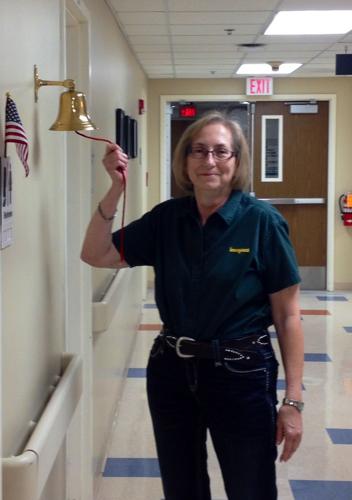
After having 40 HBOT treatments, Wessel's ulcer finally healed, 13 months after it first appeared. A rosy discoloration marks the spot where it was. Wessels walks regularly and wears a compression sleeve to promote circulation in her foot and ankle.
"When (Garrett) told me that I would have to wash this thing out daily with this little syringe, I thought, 'Oh my god, I can't stand to look at it,'" she said of the ulcer. "I look at it now and I'm just totally amazed."