



There was a time when Riverside looked like a Norman Rockwell painting. It was a reflection of true Americana, a microcosm of mom-and-pop shops with smiling children and soda fountains, barbershops, baseball and row boats.
The neighborhood’s history is wrapped in the romanticism of pioneering fur traders, amusement parks and picnics weighed against the realities of flooding and economic booms and busts.
Nestled in a bend of the Big Sioux River at the northern base of the Loess Hills, only four roads lead into the most western part of Sioux City – W. 19th Street, Military Road, War Eagle Drive and Exit 151 from Interstate 29.
Although frequented by nomadic tribes of Sioux Indians, this area remained uncharted until 1804 when the Lewis and Clark Expedition traveled up the Missouri River to explore the Louisiana Purchase, according to archives at the Sioux City Public Museum.
People are also reading…
Theophile Bruguier, who is considered the first white settler of Sioux City, established a farm and trading post near the mouth of the Big Sioux, what’s now known as Riverside. One log cabin has been preserved in the park.
As more families moved here, neighborhood promoters focused on bringing in businesses and welcomed Sioux City Vinegar & Pickling Works, the Sioux City Stoneware Company and the Liberty Cartridge Company. Shops sprang up along Military Road and Riverside Boulevard including a bakery, filling station, shoemaker, dairy, restaurant, hotel, drugstore and florist.
Perhaps the most profitable and enduring venture in Riverside was manufacturing brick. Three companies formed by 1902 and later consolidated into one operation.
Despite development, the neighborhood remained isolated from the rest of Sioux City for some time. Roads were unpaved – dry and dusty in the summer, turning muddy and treacherous in the fall and spring.
Eventually, the city extended streetcar lines from downtown to Riverside Park.
The area grew as a mecca of recreation. It had the first publicly owned golf course in the city, which operated until 1908 when the Sioux City Country Club moved to 40th and Jackson. And the Interstate Fair boasted to have some of the greatest agricultural exhibitions in the Midwest, drawing in thousands each fall from 1903 to 1926.
The abandoned fair grounds were quickly transformed into Riverview Park with a nearby track for midget auto racing.
At the height of its prosperity during World War II, the 35-acre amusement center had a roller coaster, fun house, merry-go-round, ferris wheel, tilt-a-whirl, ghost ride, chairplane, whips, electric cars, Leaping Lena, kiddie rides and a miniature train.
When the war ended and television burst on scene, business faded and finally folded in 1953.
There was plenty of wholesome family fun, including a swimming pool, built in the 1920s. It was demolished 68 years later to make way for the new aquatic center, which was the first of its kind in Sioux City to have slides and a wading pool. It was built in 1994, completed along with the $3.4 million sports complex featuring soccer fields, ball diamonds and tennis courts south of the park, which in recent years, has been the site of festivities like Riverssance, ArtSplash and Asian Fest.
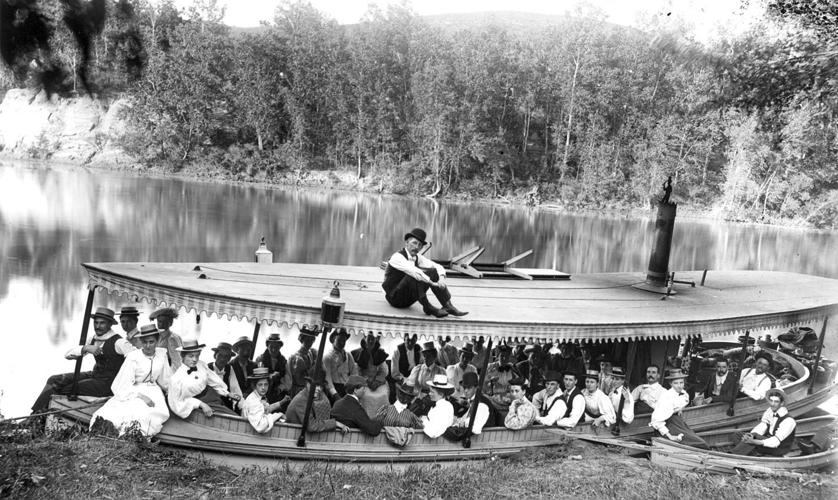
In its heyday, Riverside Park was a destination for thousands of Sioux Cityans and their friends from out of town. Sunday afternoon wasn’t complete without a boat ride on the river.
A handful of flourishing boat clubs provided canoes for members and rowboats were in high demand at the public docks. The Sioux City Community Theater’s venue on Riverside Boulevard originally served as the Commercial Men’s Boat Club and later as the Shore Acres Ballroom.
Voyagers who had no desire to paddle a canoe or row a boat traveled the river in one of the gasoline launches. A trip across the way was especially popular when Iowa law forbade selling beer on Sunday. Once suds-seekers got on South Dakota soil, they were greeted with a beer garden, which was running wide open.
Other attractions included baseball games, concert bands, roller skating and picnic lunches on the banks of the river.
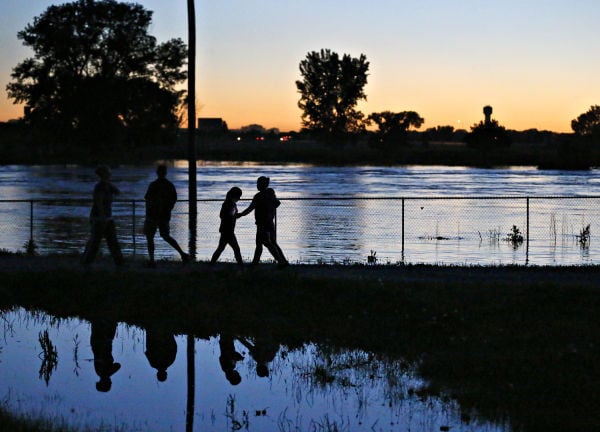
However, life along the Big Sioux could quickly take a turn from picturesque to problematic.
Record-level flooding in 1969 put North Sioux City under water and would have done the same in Riverside if it were not for a valiant sandbagging operation undertaken by a vast majority of young people.
The rambunctious river presented a spring terror almost annually to residents living nearby.
In an effort to tame the “Angry Sioux,” an $8.3 million flood-proofing project, completed in 1980, widened the river and attempted to contain it with a strait-jacket of levees, riprap and grass-sloped banks.
It took until 1968 to authorize the project even though the river had flooded its lower reaches 79 times between 1870 and 1974, causing millions of dollars in damage.
Last year, the river was expected to crest inches above the 108.3-foot record set in 1969. It peaked at 105.6 and began dropping.
Maybe the good ol’ days are gone.
Then again, looking back at records of mucky streets and jalopies that rattled out to Riverside, maybe they never truly existed. But even today, in the lazy hazy days of summer, there are still boats and ball games and moments to hold dear.


