
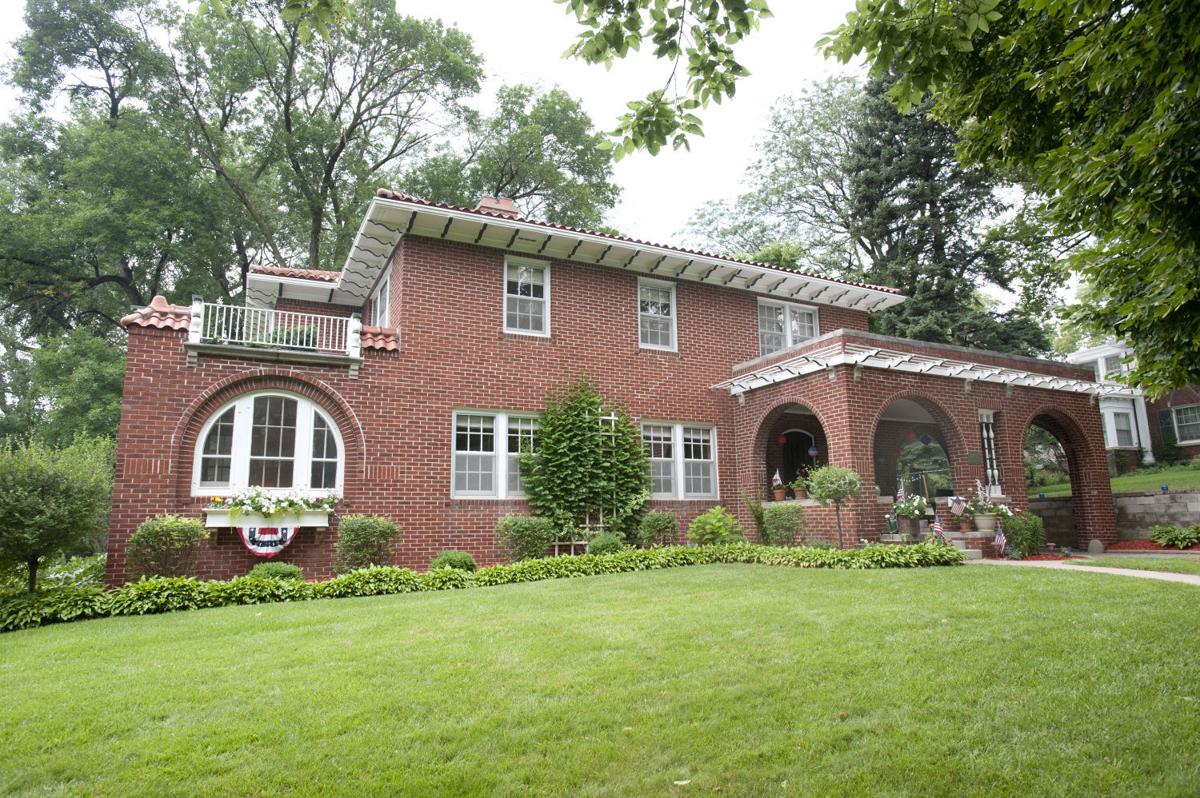
There’s a lot of love about this Historic Heights home -- from its charming façade to interior features that signal an affluent lifestyle of yore, unfettered by modern amenities.
Many original details have been left intact since the home’s only had three owners, starting with local jeweler Jacob Greenberg in 1926. Chuck Corbett, a third generation lawyer in Sioux City, bought the home in 1989 and shares it with his wife Lisa, a colorist at Belle Touche and occasional house flipper. He didn’t know much about the history when he bought it. He just liked the neighborhood and this home happened to be for sale. Now, the Corbetts undoubtedly have an appreciation for the craftsmanship of the home steeped in history, and they’re making some memories of their own.
1. Curb appeal
The arched openings of the portico and parlor windows are defining features of Romanesque Revival style architecture. Another unique detail of the home is its Spanish tile roof.
People are also reading…
2. Front porch sitting
From the front porch, which overlooks the southwest corner of Grandview Park, Chuck and Lisa can enjoy an evening meal or glass of wine while melodies carry over from the band shell. “That’s a nice reason to sit out on the porch too, being able to hear the municipal band on Sunday nights,” she said.
3. Well-laid plans
Left behind by the previous owner, the blueprints of the home hang above the stair landing. The 2,732-square-foot home was built by Beuttler & Arnold, a Sioux City architecture firm that also designed the Insurance Exchange Building, YWCA and six-story building for T.S. Martin Department Store, once called the Marshall Field’s of the Midwest, formerly at Fourth and Nebraska.
4. Restoring former glory
The Corbetts pulled up the carpeting in the living room to reveal the original hardwood floors that they were able to have restored. Some wallpaper came down and pieces of furniture were reupholstered to give this room an update while trying to stay true to the period.
5. Family heirlooms
In one corner of the living room, Chuck keeps his Edison disc phonograph from the early 1900s that belonged to his grandparents. “They had a cottage at Okoboji, and my aunt wanted to turn it into a planter. I think this was back when I was in college, and I said, ‘Well, you can’t do that.’ Shortly after that, they gave it to me.”
6. Peak into the past
The formal parlor or sunroom was a popular home feature in the 1920s. Historically, the parlor was a place for entertaining special guests, playing games and hosting funerals.
7. Cabinets and marble counters
Bringing an old home into a new century presents certain challenges. Back in the day, the Greenbergs had an icebox in the pantry and the Corbetts wanted to fit a refrigerator in the kitchen. They reconfigured the small space slightly, preserving the original marble countertops and cabinetry, but they removed a large cast iron sink – and turned into a patio planter – to make way for a smaller basin with a garbage disposal and dishwasher nearby.
8. All the remains
When they tore up the carpet, they discovered an odd hole in the middle of the floor. “We learned that is actually a butler bell,” she said. Whenever the family was eating and wanted something brought in from the kitchen, they could ring the bell by foot and the butler would appear. “The butler hasn’t shown up yet for us,” she said with a laugh.
9. Period pieces
Chuck collected furnishings, circa 1926, from auctions, estate sales and eBay. A neat feature of the master bedroom is a roof terrace that can only be accessed through the window.
10. Living history
The window-lined sleeping porch on the second floor is callback to days before air conditioning. There are other remnants of the era like two sets of stairs – one in the reception hall and another narrow set right off kitchen for the maid, who had a second floor bedroom with a little balcony. “You think, gee, that’s pretty nice,” Chuck said. “But on the blueprints, it also called this the drying porch. So the idea was this is where she would bring the laundry up and hang it up to dry.”